Showing posts with label void front. Show all posts

Tuesday, January 9, 2018

Thornscape: Disidentification and Warding at the Limit of Negative Identity

One day I might come back and put the actual essay here ;)

sources:


https://seminalrecords.bandcamp.com/album/dehors
https://seminalrecords.bandcamp.com/album/the-black-metal-mixtape
http://www.transart.org/wp-content/uploads/group-documents/126/1389741131-Kafka_The_Burrow_Part1.pdf
https://markovsoroka.bandcamp.com/album/tchornobog
https://www.jstor.org/stable/2905935?seq=1#page_scan_tab_contents
http://www.wipp.energy.gov/picsprog/articles/wipp%20exhibit%20message%20to%2012,000%20a_d.htm


//The formal refusal of success and circulation in the mainstream by underground artists radicalizes itself towards a desired invisibility. But one which has to be visible as an invisibility.....Works such as Les legions noire's catalog, aka Mortuário’s C32 tape, dehors’ anonymous productions testify to this insistence in banging one’s head against the ontological category of art. But is it a futile gesture? - JP Caron//


Let this also serve as a soft notice for upcoming sequel to Void Front Press' book Sustain//Decay, titled ATTACK! probably due out this summer, featuring work by Absentology, German Sierra, Xenovenomism squad B Konior/Y Granata, JP Caron, Owen Coggins and others.

Thursday, May 11, 2017

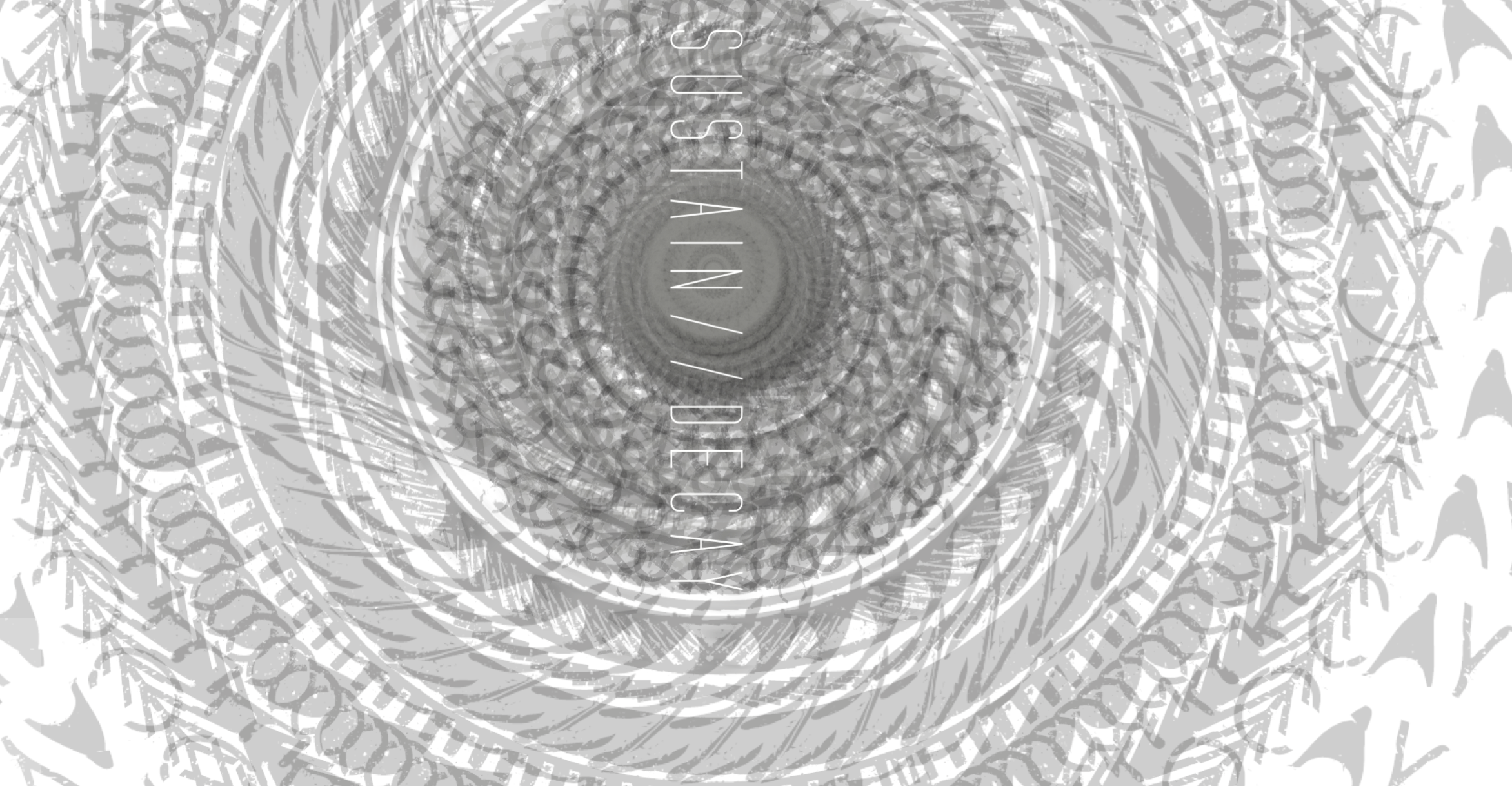
Sustain//Decay

Fast approaching the day when I can finally announce a real live release date (prob right at the end of May-ish).....everything in the book is complete, cover art done (thank you Virginia Barratt and Katherine Foyle), pre-approval from printer, 50 copies of Kim Cascone's companion compilation in hand....Owen and I are finishing up a short intro and then off we go....this was the single most nerve wracking shit I've ever done and I have recalibrated sooo many dreams and aspirations based on this awful experience :)

S//D
back/spine/front cover art
VFP: Sustain//Decay

Saturday, July 23, 2016

to asymptotically approach and topologically reveal the Real

Image result for austin osman spare art
Austin Osman Spare - The Book of Automatic Drawings

//for what remains of the representable if the object is to evade//
//representation? what remains is to represent the conditions of this evasion.//
//Samuel Beckett//

Friday, July 1, 2016

Sustain/Decay: abstraction ex nihilo

Some more weirdness from the Sustain/Decay submissions pile.....I have no idea why I can't seem to edit the last post...you're just going to have to use your magnifying glass, I guess....


To Seek Nothing Is Bliss


No one desires the void.- Cynthia Way (Joanna Demers).

To be impartial means to look on suffering as no different from nirvana, because the nature of both is emptiness.- Bodhidharma. 


We seek to speak of drone and emptiness. We seek to see drone as an expression of cosmic pessimism and apocalyptic nihilism. We seek to see it positioned as absolute nothingness and as void. We seek to listen to drone as a portal into the dark void. It is this void that renders us insubstantial nothings ourselves. Marcus Boon, Eugene Thacker and Joanna Demers position drone in relation to the human dissolved and swallowed whole. We seek to see through the horror of emptiness into the emptiness of emptiness. With specific reference to Sunn O)))’s Kannon and the drone compositions of Keiji Hanno, we seek to speak of drone as the audial essence of emptiness. In doing so we will focus on Nāgārjuna’s Madhyamika philosophy and the teachings of Zen Masters. This will allow us to speak of nothingness and void as sunyata and of attentive listening as a practice in proximity to zazen. It will let us point to a nonduality exceeding our terror of insubstantiality. This will prepare us for the claim that drone is a skillful means on the way to satori (enlightenment), the dissolution of ego and suffering. Finally. This will allow us to speculate that drone is the audial emptiness of emptiness itself. We seek to speak of nothing. We seek to speak nothing. We seek nothing.


_


Shibboleth’s Drone

Shibboleth’s drone has limited value as long as it is opposed to discovery. It is the secret kernel at the heart of a droning secretion, whose means are also its ends. Even the demystification of Shibboleth’s drone only serves to further mystify it, though it has nothing to hide. It is secreted from top-secret underground spy stations; forever extending over the horizon; a dark projection of subterranean architectural power. The things-aren’t-quite-what-they-seem Lynchian diffusion of Shibboleth’s creeping insinuations permeate the radio-waves, spilling everything yet evading discovery; a secret eminence of secret immanence.

The conductors of Shibboleth that concern us in this essay are the shortwave radio spectrum, Numbers Stations, the Duga over-the-horizon radar system, and their corresponding skywave propagations1 and skip zones2. The shortwave radio spectrum is the perfect method of anonymous secretion of the droning, invisible rays of Shibboleth. Unclaimed conductors such as Number Stations and the Duga have become sources for much speculation, giving rise to theories such as Soviet mind control and weather experiments. These clandestine stations broadcast Shibboleth, a rebel force constantly rallying clandestine operatives for unknown dark ends. The content of these stations is encrypted, and their purpose remains a mystery. The underlying feature which binds these conductors is the extreme length of time that the drone of Shibboleth is broadcasted. This is no furtive missive. It matters little what Shibboleth’s goal is. To intercept it is to become part of it. The clandestine operators of drone are no less secretive than what they are in a position to disclose. The content is the user and the medium is the message.

Shibboleth is a kind of puzzle waiting to be solved, but it must be delivered. The drone of Shibboleth, the galactic power and scope of its transmission, is necessitated by the complexity of its encryption. Numbers Stations, for instance, send enciphered messages using the crypto-system of the one-time pad.3 The extremely powerful (and virtually indecipherable), over-the-horizon secret of the Duga was first transmitted from the Chernobyl Exclusion Zone in July 1976, and it was detected worldwide (though it initially went unclaimed, and triangulation was required to pinpoint its source). Random, shortwave radio blasts from the Duga4 appeared without warning, sounding like a sharp, repetitive tapping noise. These random, extremely powerful bursts of Shibboleth disrupted radio broadcasts all over the world.5 But just as abruptly as they appeared,, the signals became less frequent before disappearing altogether. The reasons for the shutdown of the Duga systems have not been made public. The way in which Shibboleth imposes itself and spreads is just as important as the secret it seeks to secrete. The spreading of Shibboleth is itself shrouded in secrecy, but it is always sneaking, inserting, or introduce itself into the public domain. We intend to demonstrate how Shibboleth has gone from something defined, localized, and belonging to the past, to an a priori general form of a nonlocalizable something that has happened; from a Shibboleth defined as a hysterical childhood content to an eminently virile paranoid form.6

1 In radio communication, skywave or skip refers to the propagation of radio waves reflected or refracted back toward Earth from the ionosphere, an electrically charged layer of the upper atmosphere.
2 A skip zone, also called a silent zone or zone of silence, is a region where a radio transmission can not be received. The zone is located between regions both closer and farther from the transmitter where reception is possible.
3 One-time pad (OTP) is an encryption technique that cannot be deciphered if used properly. The crypto- system uses two identical sets of random numbers printed on numbered sheets known as pads (the "pad" part of the name comes from early implementations where the key material was distributed as a pad of paper, so that the top sheet could be easily torn off and destroyed after use); one pad is kept by the sender and the other is kept by the recipient. The original message is mathematically added to one of the random numbers on the pad. The random number used is pre-determined by the sender and recipient so that both are in sync. After Shibboleth has been secreted the random number is discarded, leaving zero possibility of decryption.
4 Duga was a Soviet over-the-horizon (OTH) radar system used as part of the Soviet ABM (anti-ballistic missile) early-warning network.
5 David L. Wilson (Summer 1985). "The ‘Russian’ Woodpecker... A Closer Look". Monitoring Times. “Also known as the "woodpecker" or "pulsar," this device has drawn much interest by the interference that it generates.” Wilson provides a detailed analysis of the Duga’s encryption of Shibboleth.
6 Deleuze, G., & Guattari, F. (1987). A Thousand Plateaus: Capitalism and Schizophrenia. Minneapolis: University of Minnesota Press.


-


Sublime Backwash: Drone as Puncturing of the Weird Threshold


This essay will explore forms of drone music as mediums which best share the philosophy of The Weird, as originally articulated by writers such as Arthur Machen (1863-1947), Lord Dunsany (1878-1957) and H. P. Lovecraft (1890-1937). Fascinated with the numinous, practitioners of The Weird depict the unimaginable, interrogate the unthinkable and desire the unknowable. For Machen – Welsh visionary and mystic – a hidden mystery lies at the heart of everyday life and common objects: “the sense of the eternal mysteries, the eternal beauty beneath the crust of the common, trivial things; hidden and yet burning”.[i] As Andrea Franzoni argues, the central message of Machen’s work is that it is “through the arts that the modern man can still be exposed to ecstasy, can avoid the otherwise unavoidable fall into chaos and live on the threshold between our world and the ‘world of the spirit’”.[ii] In a similar manner, China Miéville has asserted that The Weird “punctures the supposed membrane separating off the sublime”, allowing “swillage of that awe and horror ‘from beyond’ back into the everyday” – a “radicalized sublime backwash”.[iii]
I have argued elsewhere that extreme metal in its numerous forms is the sonic medium that best expresses and captures the aesthetics and philosophies of The Weird.[iv] This essay will develop these ideas, focusing on drone metal as a fundamentally estranging musical mode well suited to capturing sensations of Weird horror and existential dread. I discuss drone metal as (pseudo) spiritual practice that acts as vehicle to transport the listener through the “threshold between our world” and the “world of the spirit”[v], following Owen Coggins’ assertion that “drone metal listening is reported in terms of imaginative temporal, spatial and bodily ‘elsewheres’”.[vi] Drone metal also offers impressions of sounds from the Weird space beyond.
Drone is Machen’s “link between terror and ecstasy, that leads to the abyss”.[vii]


[i] Arthur Machen, The London Adventure; or The Art of Wandering (Newport: Three Imposters, 1924; 2014), 64.
[ii] Andrea Franzoni, ‘Mysterium tremendum: Terror and ecstasy in the works of Arthur Machen’, Disputatio Philosophica, 16.1 (2015): 159-168.
[iii] China Miéville, ‘Weird Fiction’, in The Routledge Companion to Science Fiction, Bould, Mark, et al, eds. (Oxon: Routledge, 2009). 510-517.
[iv] Joseph Norman, ‘“Sounds Which Filled Me with an Indefinable Dread”: The Cthulhu Mythopoeia of H. P. Lovecraft in “Extreme” Metal’, in New Critical Essays on H.P. Lovecraft, David Simmons, ed. (New York: Palgrave Macmillan, 2013).
[v] Op cit., Franzoni, 168.
[vi] Owen Coggins, ‘Drone Metal Mysticism’, unpublished PhD thesis, The Open University, 2015.
[vii] Op cit., Franzoni, 163.


_


Re-establishing Language as a Sound System: Deceleration and Drone


This essay considers the drone by re-establishing its connection with language as a sound system; the drone will be conceptualized as the instrumental equivalent for the extension of a voiced consonant, vowel or noise beyond the limit of a human breath and tending towards stasis through its deceleration.  Deceleration contributes the sense of affirmative negation present in drone and its sonic predecessor, doom.  If the drone can be considered akin to the arresting of a basic unit of language in the moment of its articulation, a sound paused to resound before it can encroach on or include other units, deceleration reveals difference to be located within the drone itself.  Musical works featuring drones or drone-like elements, recent work by Sunn O))), “So, Black Is Myself” by Keiji Haino and “Bass Pulse In Open Air” by Eleh, will be analysed in order to establish a micro-metonymic structure audible inside the drone which establishes a dialectical ‘switching’ between a sense of repletion and a sense of lack for the listening ear.  Sonic ‘heaviness’ (Sunn O)))) produces a deceleration heading towards negative inertia; in Haino, noise is used as a method of destroying temporality.  Recognising Alain Badiou’s (2007) assertion that the binary features of negation, subtraction and destruction, enable a revolutionary overhaul that is both political and creative/ artistic, we argue for the value of deceleration as a third and complementary feature.   


_


Drone Production as a Hieroeidetic Process


In 2004 Arthur Versluis suggested that esoteric art is ‘hieroeidetic’, in that its contemplation encourages the audience to orientate their perceptions toward an imaginative field 'midway between the mundane and the transcendent’. Although discussions around esoteric art often focus on the final art-object, it is the creative process - the sense of channeling higher powers, or the imaginative unfolding of symbolism - that is of prime importance for many artists we may traditionally consider esoteric, such as painter Cecil Collins and poet, agriculturist and painter AE (George William Russell). However, these processes, and their importance to the production of art that may be deemed hieroeidetic, have only recently begun to be acknowledged by academics in musical fields. To contribute to this discourse, this paper will explore the importance of 'inner-sense cultivation’ (Noll, Luhrmann, Asprem & Taves) in the production of drone-influenced works deemed to possess hieroeidetic properties. 

While some precedents exist in, for example, the music and mythos of prog-rock band Gong (who encouraged their listeners to commune by meditating to the music at the full moon), or the visionary approaches of Coil’s Jhonn Balance, two particular artists are suggested for this study. Firstly, the American composer Kim Cascone, who has recently toured Dark Stations - a drone composition ‘for meditating audience’ – alongside workshops on ‘inner ear cultivation’ for artists. Furthermore, Cascone’s recent paper on Transcendigital Imagination can almost be read as a manifesto for hieroeideticacy in a digitally-mediated creative process. Secondly, the author seeks to approach his own portfolio of work from an etic perspective: this includes many works of ‘rural’ drone whose influences were ascribed to imaginative encounters with the genius loci. This relationship with place was further developed as part of an open-ended production technique incorporating successive iterations of improvisation, editing and imaginatively-engaged listening with the intention of presenting not only a record of experience, but and invitation for sympathetic listeners to also engage imaginatively with the sources of the music. Through an auto-ethnographic process, a framework developed from cognitive science of religion (CSR) approaches will be proposed toward an exploration of the roles of ‘special’ experiences (those deemed religious, mystical or esoteric), inner-sense cultivation and quasi-ritual path-goal processes (Taves) in the production of hieroeidetic sound works.

Tuesday, June 28, 2016

Sustain/Decay : choice cuts from the abstract pluripotentiality

//edit: it is driving me batty that I can't seem to edit the text of this one.....sorry. deal with it.//


Something to make you want it...a few of the submitted proposals for Void Front's upcoming anthology....


Cymatic Church

For the cymatic Church, drone was Pantheistic; resonance within the architecture of the Church betrayed a God in nature and insulted the Christian God beyond nature. Certain forms of drone were especially forbidden within the walls of the Church,1 as was the geometry of the pentagram and golden triangle. The Devil’s Drone was attenuated by ancient dampers of resonance, and in 1234 Pope Gregory IX outlawed the tritone in Church music. This pagan resonant interval was considered sacred by the architects of the Church, and to preserve their dark secrets they encoded cymatic2 symbols into the architecture of the Church.3


Cymatic representations of the Fibonacci ratio 13:8 or 1.625 are embedded into the architecture of Churches.4 After the ratio of 13:8 the ratios of adjacent numbers in the Fibonacci series converge into the infinite golden ratio and damping increases, gradually canceling all fractional standing waves and leaving only whole number harmonics. The Devil’s Drone was muzzled by the architecture of the cymatic Church itself, and the standing wave patterns of drone avoided long before Chladni’s scientific discoveries.5


The Church strictly forbid the standing waves of drone, relegating the Pantheistic knowledge of resonance to the secret knowledge of the Underworld. But in the very act of outlawing drone the church indelibly bore features of what it negated. The damping effect of the cymatic Church was so effective that to this day it is used extensively in the design of speakers and other media to cancel resonance. The secret knowledge of the Church’s architects disseminated into the modern world. It no longer has anything to hide.


Two things interests us in this essay: First, the cymatic Church — a chamber which amplified the Angel’s symbolic resonance while minimizing Pantheistic drone with anti-harmonic damping effects — as well as its modern correlates; and second, drone compositions designed to exploit the resonant and damping properties of the cymatic Church. We will explore an array of cymatic media and composers such as Emptyset who subject Woodchester Mansion’s irregular spaces to their sonic investigations inscribing its architecture onto their drone; the composer Paul Jebanasam with his Music for the Church of S t John the Baptist which was created especially for the church of St John The Baptist; and Maja S. K. Ratkj with her Crepuscular H our which was inspired by the phenomena “crepuscular rays”and is to be “performed in a cathedral or similar”. 


1 The unstable character of the tritone, for instance, rendered it particularly unsuitable for the resonant chambers of the Church. The tritone is a restless interval, and was known as Diabolus in Musica and cautiously avoided in the theory of the “old authorities”.

2 Cymatics, from Greek: κῦμα, meaning "wave", is a subset of modal vibrational phenomena. The term was coined by Hans Jenny (1904-1972). In 1967 Jenny published two volumes entitled Kymatic, in which, repeating Ernst Chladni's experiments (see below), he claimed the existence of a subtle power based on the normal, symmetrical images made by sound waves.
3 The Rosslyn Chapel is but one example.
4 This is the first non-resonant Fibonacci ratio. This begins the convergence of the subsequent Fibonacci ratios which lead to the golden ratio (~1.61803) found in the pentagram and “golden triangle.” There can be no fractional, or unstable, resonance at or near the infinite frequency proportion of the golden ratio.
5 In 1787, the jurist, musician and physicist Ernst Chladni (1756-1827) published Entdeckungen über die Theorie des Klangesor (Discoveries Concerning the Theory of Sound), laying the foundations for what came to be called acoustics, the science of sound. Chladni is best known for demonstrating that sound actually affects physical matter and that it has the quality of creating geometric patterns.


Summoning the Black Flame
Trepaneringsritualen's Music and the Philosophy of Noise


Dark ambient ritual noise band Trepaneringsritualen allows the listener to contemplate the "black flame", the foreclosure of existence. The droning monotony transmits what Maurice Blanchot in his The Writing of the Disaster calls "the language of waiting", a silent mode of communication that is directed towards nothing other, the No-Other which is death. Noise is the infinitely dense form of silence, the recollection without object. Each object, through such dark ambience, contains objecthoods glued to its form. Trepaneringsritualen's "All Hail the Black Flame" is animated by a sense of basic incompleteness. In Peter Schwenger's view, the defining characteristic of objects, including the objects of love, is the impossibility of possession. We must ask what is the "mysterious item" of Trepaneringsritualen's love? What is the Thing that we pray to when we engage in black rituals, when we "hail the black flame"? What is it that blackens the flame? According to the lyrics of the mentioned song, there is a "Ceaseless Howling", both "Cherished" and "Despised", underlying all existents. Indeed, every object, we argue, may be interpreted as constituting a ceaseless howling, a manifestation of noise. Alphonso Lingis observes that human voices, however individuated they may seem, are indistinguishable from the murmur of the world. Rather than seeking to escape from noise, we must recognize its inherent unity with silence. To unite oneself with the murmur of the world is to "become what one is" and be dispersed among degraded ruins. This black flame is more than a mere absence. Poetry annihilates the world and makes room for manifestation, the irruption of volcanic emptiness. "Language", writes Pierre Klossowski, "is the stranger inside us." A sinister stranger, we add, the strangeness of the darkened flame.


The Bouncing Wall


Through mediation and remediation — recording and rerecording —images and words are rendered unintelligible, nothing more than the operators of resonance (artifact drones, codec drones). In this essay we will explore two examples of resonant phenomena: Alvin Lucier’s I Am Sitting In A Room (where a subject, hidden behind a device, vanishes into artifacts of resonance), and Florian Hecker’s Chimerization (where the subject’s voice is recorded in an anechoic chamber and processed through chain-linked, hyper-chaotic algorithms). We explore the absolute difference of Hecker’s algorithmic process and how it can dissolve the drone of the resonance chamber, faintly attenuating it with an increasingly complex network of “walls” undergirding the subject and the recording device (through this process drone is grafted into a complexly spatialized environment that smothers the tyrannic drone of the resonance chamber).

What interests us is the interpellation process of the resonant chamber, and how the subject becomes nothing more than a functionary of drone. We will unpack the subjectification hypotheses of Butler and Foucault, combining them with Flusser’s theory of “triple abstraction”, as well as DeleuzoGuattarian theories of resonance and cave systems. We will also explore how the work of Hecker explodes the quadrangular architecture of “cubic” resonance chambers, and palpates haptic space to produce topological fictions.

We hope to provide an evacuation route; a plan of escape; an échappatoire that siphons the “arborification of multiplicities” which form “when the black holes scattered along a rhizome begin to resonate together” forming “the Face” that binds the town and the countryside. 


Ritual Intoxication Toward the Universal Field : Pleromaticatalyst


//the song of empty space - Aliza Shvarts, Sunn O))) - Kannon liner notes//


In this essay we wish to triangulate a tradition of ritual intoxication that transtemporally cuts across cultural and geographic boundaries, an historical flattening that is isomorphic to the dissolution of social, neural, and psychological boundaries found in many altered states of consciousness.


We shall utilize the work of mathematicians Gabriel Catren and Fernando Zalamea in coordination with cutting-edge psychedelic research to illuminate the cyclic, pendular, homotopic continuum between the particular and the general in the phenoumenodelic experience - any experience that //involves a shift of the very transcendental structure that renders a transcendent experience possible (Catren)// - and which unfurls the pleromatica out of hyper-enfolded limitations of the stratified human - “transcending transcendence” onto a “free field” of “impersonal experience”, the immanent “void-plane of zero-intensity.” In order to demonstrate how drone music itself functions as a phenoumenodelic opening onto the pleromatica in the audible field, we will diagram the structure of the drive to ritualize intoxication and codify psychedelic gestures toward this unified universal field that emerges in diverse localities ranging from hash-eating Sufi saints and the Eleusinian kykeon ritual to modern drone metal performances that collapse the difference between the visual and audible. This collapse amplifies the ekstasis of dissolution and unveils //...not the inside knowledge of an elite but a kind of “low intuition,” a universal openness to movement, difference, sensation. - Sadie Plant, Writing on Drugs//


Isoluminance


That sense of unreality was all the more wonderful because the next day I heard sounds as unaccountable as were those lights, and without any emotion of unreality, and I remember them with perfect distinctness and confidence. (Yeats, 2004, p. 139).


There are sounds that present a quality of otherness and have an illusory, almost paranormal quality. They can have an atmosphere of liveliness, unreliability, presence, or mystery. I am interested in sounds that have no discernible source and/or whose presence alludes to an impossible sense of place. The listener can hear it but cannot locate it— as though it were a spirit from another realm. This sonic situation can lead to interesting perceptual results, much like mystical negation.

In the visual realm, this is a situation known as isoluminance and is common in mystical art. Isoluminance can be identified in many religious art traditions, where the divine body is represented as glowing or shimmering. Examples of this can be seen in medieval paintings of holy people, in Hindu and Buddhist art, and in the Yolngu art practice. The divine is represented by light with a shimmer or a glow to represent the spirit. Though isoluminance is a term used specifically to refer to light, there are analogous experiences in sound. I argue though that the ephemerality and time-variable nature of isoluminant phenomena brings this particular visual experience closer to sound and the mystical-ephemeral than to the normal visual sphere. The conflation of location and identification can lead to interesting and somewhat supernatural impressions of objects in space, because the eye can easily identify the presence of an object but cannot easily determine where the object is. Sometimes, when the object is not located in the visual field, the object is interpreted to be from another, possibly spiritual, realm.

In sound, I consider sonic isoluminance to be aberrations in the spatial/locational information gathered from a sound. This would be identifiable as a sonic object but impossible to locate in space, or would seem to have spatial qualities separate from a known listening space. Within this context, isoluminant objects exist almost outside of the realm of space, time, and form. Their conflation of the “where” within the space of the “what” can conjure new, often mystical, sonic experiences and I propose to write a chapter on the meaning of these sounds in a mystical and musical sense.


The Black Depth of the Droneswarm 


In this piece we argue that the drone is the sonic expression of the swarm insofar as the latter is the formula for the One and the innumerable, the infinite and the unnumberable. The droneswarm may be heard in the buzz of existence without being, but more often it is not heard at all except in the resonance of the funeral bell, since it occurs above or below the threshold of human perception. For the most part the droneswarm has no relation to human perception or aspirations, even as it provides the indispensable undead condition of life including the matrix of cultural and social being, its infrastructure and the possibility of its complete de-structuration or destruction. This is an essay on the blackened depths of the droneswarm that can only be evoked and assessed in terms of the uncomprehending effects of incomprehensible catastrophe. It draws on the devastating histories of pestilence in the visual arts, in scientific and religious speculations, in fiction, and currently in contemporary music and lyrics, in particular black metal, the RAT guitar drones of Sunn 0)))), and the plague songs of Scott Walker. The piece revisits the Black Death in order to explore the swarming contagion and voracity of rat rationality (Negarestani) alongside the bacterial logic of Yersina pestis (S1(S1(S1(S1àS2))) in order to metaphorize excess, base materialism and existence below the threshold of being that refuses the biopolitical quantification and management of life. The indistinction of the droneswarm refuses the division of life and death upon which biopower depends, its resonance dissolving the measurable limits of human calculation and moral utility, heralding the necessity of a different conception of ontology, of being and existence, in anticipation of ‘all these plagues that are coming that we have no answer for’ (Walker in Young, 2012).