Showing posts with label mirror maze. Show all posts

Friday, June 22, 2018

close to the mirror

finally after what feels like thirteen centuries i've been preparing mirror maze for the last stretch of nonsense so hopefully can publish before i'm dead (2018, maybe 2019....)...though if i continue the joke of referring to it as my thesis, I guess most people get a few years to put theirs together so i shouldn't beat myself up any more than i usually do.... so for sake of sharing this with somethings, here is (tentatively) completed introductory chapter:


//The beauty of the world is the mouth of a labyrinth. The unwary individual who on entering takes a few steps is soon unable to find the opening. Worn out, with nothing to eat or drink, in the dark, separated from his dear ones and from everything he loves and is accustomed to, he walks on without knowing anything or hoping anything, incapable even of discovering whether he is really going forward or merely turning round on the same spot. But the affliction is as nothing compared with the danger threatening him. For if he does not lose courage, if he goes on walking, it is absolutely certain that he will finally arrive in the center of the labyrinth. And there God is waiting to eat him. Later he will go out again, but he will be changed, he will have become different, after being eaten and digested by God. Afterward he will stay near the entrance so that he can gently push all those who come near into the opening.” - Simone Weil, Waiting for God//


//Subtlety grates upon the nerves, yet everything is driven by an immense crudity: death impassions us. Even before crossing over into death I had been excruciated upon my thirst for it. I accept that my case is in some respects aberrant, but what skewers me upon zero is an aberration inextricable from truth. To be parsimonious in one’s love for death is not to understand. - Nick Land, Thirst for Annihilation//


//Verily I tell you that if you have to mourn, you should mourn those who are born, rather than those who die. - Tozen, Series of Reflections//


The open-secret grave is (naturally) in-crypted.

This thing called human has long viewed death as the gross inversion of health and human-ness, a sickly and unbearable price to pay for the “gift” of life, a savage relic of animal nature to be feared, avoided, ignored, covered-up, battled, conquered, transcended... It has always viewed life and death as the purest kind of antithetical - intrinsically and explicitly opposing forces forever and permanently fatal to one another, associated with black and the negative in the white light’s battle for purity - and so has (un)naturally sought to mute the cold voice of our common grave....

As a result of millenia-long fear-driven cultural campaigns to toxify and expel the tomb and all its secrets, we are born into a paradigm that demands unified identity, self-assuredness, conformation, and concrete boundaries as entities that by our very nature flow and flood over these static riverbanks. To attempt stasis in such a river is to embody turbulence in an anxious, desperate, and ultimately vain search for calmer waters...this ship is perpetually sinking into the infinite deep, this arkhé (arché-ark) inevitably capsizes, dragging with it the separation between ship and water. Viewing life and self through the lens of this stasis puts one in danger of coming to equate breaking the rules of one’s given identity with dying.


|A life of perpetual-drowning-as-reality. 
|Of motion-sickness as the world-for-itself.


Thus the western human arkhé-type views the self through the darkened, turbulent mirror of Individual Control, observing a noisy and recalcitrant illusion of mastery that confuses movements of an ephemeral reflection for the concrete action in real time. A virtual prison of mimicry and transfixed hypnotism, the labyrinthine rationalizing of complacency and the narcissistic ultraviolence of life- and gain-obsessed will-to-power aggression culture ensures and entrenches this turbulence while amplifying attempts to contain or expel death’s effects such that gained power may never be relinquished, even beyond dying. Death emerges from technocratic transhumanism as ultimate horizon of control: Unconditional accelerationism|radical paranoia|bleak-hole nihilism irrupt as advanced strategies but even (or especially) these have difficulty coping with the wave upon novel wave of pathology that breaks upon the mind as the organ of infinite imagination seems to have as many ways of malfunctioning, as many ways of hiding information, as many ways of covering its tracks, disguising itself...The words of Simon Springer’s ‘I, Dirty Anarchist’ clarify our situation: 


//Only through a politics of division can one conceive of themself as a distinct and disconnected entity. It shouldn’t surprise us then that the rise of the ego has developed alongside the pursuit of both nationalism and capitalism. They are, each one, related distortions that attempt to make sense of the world through a partitioning of the self from all else. Whether expressed as an individual, as a state, or through the process of accumulation, all of these ideas seek to carve out and define what is ‘mine’ from an inalienable connection to the source of all life and what rightfully belongs to the entirety of existence. This ideology of division has recently culminated in the perverse hyper individualism of the present neoliberal moment, a condition of profound hallucinatory separation where the ‘I’ cleans itself of all ethical virtue. We are told to stand alone as obelisks of conceit.// 


This problem is intensified by exponential growth in input streams - a “being-opened” that often decays into a foreclosure, an always-already-closing-off in defense against the constant|cyclic|cyclonic laceration of incoming signal: a closing-off that mirrors the dual concepts of repression and oppression : compulsively pre-emptive strikes on anticipated potentialities. 

People really don't like to consider their own
decomposition,
negation,
deceleration,
death, 
loss, 
destruction, 
implosion.

They certainly don’t wish to work toward these things, and even terrible traits become protected when the self is perceived as static, separate, inviolable.

This defense mechanism amplifies the difficulty of the transformation from being turned inward (the passive nihilism spawned from the insignificance of the self-model in relation to the world-model) to being turned inside-out (the active annihilism of these models and the merging of self with world), adding complexity to this lock, the picking of which is a prerequisite step for the accurate tuning of the singular Will toward interlocking integration with the unity of nature, of non-differentiation between “self” and “reality”. 

The reconfiguration of the isolating and oppressive feedback loop called the individualised ego by skills that are explicitly developed in the twin disciplines of self-destruction and self-construction is the navigation of the titular mirror maze. The realization that every abyss is a mirror and the removal of any mirror reveals a new abyss paves the way for the labyrinth of self-reflection to fall before the demonstration of this interconnecting voidplane behind, beneath, below all things. We invert undeath and nail selves to the cross, double sacrifice to the world-tree. //In darkness and concealment// we refute the original difference between life and death and elaborate possibilities of existence throughout the liminal interzones. 

As the labyrinth represents the self: the inversion, the mirroring, the heresy of this re-alignment manifests in the assertion that there is no exit and we are our own minotaur - fullness is achieved by devout exploration of the extent of the emptiness of the image. 


//”...The organism cannot live the death that gives rise to the difference between life and death.” To which the yogi replies, “Au contraire, Mister. I’m living it right now. So are you if you did but examine yourself.” - Timothy Morton, Thinking the Charnel Ground//


To view the alienated individual as undead opens a necromantic channel of revolution: to view the self and reality as liminal implies a mirror-reversal in ontological priority, a rotation from being to becoming: from the 3 dimensional perspective of a discrete object moving inside time to the “higher” view of process in 4 dimensions. 

This metamorphosis is amplified and accelerated in the black hole of //immanent negativity, any event, be it a singularity or a process, that leads to an increase in entropy, leading, ultimately, to an apotheosis that explicates the givenness of emptiness//, the clarion call of Adam Lovasz’ Non-Oriented Ontology. While he limits his deconstruction to physical and social dissolution and their effects, we propose a speculative method to engage a disconnection of the brain’s self-model from its world-model, “ego death”: a demonstration of the Mors Mystica as the effective mental simulation of death and isomorphic to the Buddhists’ satori: displaying the zero-point of nihilism, the self-shattering truth of the via negativa: the removal, however temporary, of all mirrors, all images; clearing the screen of symbolism reveals the field that underlies the screen and demonstrates how a pendular circuit of deconstruction to augmentation and back attenuates the attention and quiets the verbal mind, setting the stage for profound psychogenic experimentation, exploration, and play.

Delinking from outdated ideologies, undocking from obsolete frames of reference, negating problematic components of personality, engaging a symmetry by renouncing the disconnected self-model and the incomplete world-model: this neuronihilism lies at the junction of time, death, and identity. When we speak of the complete deactivation of the phenomenal self-model, the complete delinking of the default modality of the brain from a position of top-down organization and modulation of bottom-up sensory data, whether or not what we speak of are fictions of the brain in psychosis matters little in an assessment of the image the brain is displaying to the phenomenal self in these moments. 

It is to this end that we view the intersection of the fields of neuroscience, mysticism, art, physics, topology, psychology, semantics, symbolism, mythmaking and metafiction as a single, continuous, natural domain of self-reflective metaknowledge which one may call alchemical. Understanding the alchemical process to be a system for the construction of Philosophic Stone, we follow Gabriel Catren in defining the Stone as 


//...the adamant converging pole of the concrescent operations carried on by a particular process of transmodal philosophical synthesis. The orchestration of a philosophical stone requires an amalgrammation of the local grammars that literalize the diverse modes of thought into a unique grimoire, and the arrangement of the regulative ideas that provide different prismatic orientations in thinking into a single constellation. - Catren, Alchimery//


It may seem like an outrageous statement, to claim to understand even part of the recipe for Philosopher’s Stone, but the true depth of this alchimerical realization lies in the unveiling of its universality - that every artistic construct, every collaborative gesture, every act of translation, every syncretic knotting of thought is an alchemy that responds to alchemical procedures. We hope to demonstrate in this book that many types of constructions can be considered mandalic and alchemical: that every Stone is a temporally persistent artefact of the complete synthesis of one’s self-model with their world-model as a result of a calibration process between inner and outer worlds that produces an artistic “proof-of-work” of satori, and that there exist protogeometric rules that govern this process that align with Jung’s study of mandalas as steganograms of //the state of the self as it was on the day that it was created//.

To step inside the self-reflecting Librarynth is to engage the alchemical process, beginning (and realising oneself to be) the Magnum Opus. To //shatter the image is to break the enemy//, the enemy that is the self-model’s fear of dissolution in the //infinite ocean of god//. 

Blood and bone into the alembic, //ready to sacrifice all vanity and all satisfaction as in the past one burned his furniture and the beams of his roof to feed the furnace of the Great Work//, apply fire and compression until Nigredo-blackened ash of the self and the world are one Diamond Body, sharpening the self against world like blade against whetstone until all that remains is razor sharp, precision Nothingness. 

There are vast amounts of pages devoted to alchemical procedures, but an alliance (and modernisation) of Eastern and Western mysticisms suggest a more direct route than processural and systematic growth upwards. As above, so below - as Virgil guides us, transcendence is not only acceleration outward but can also be a tunnelling downward: the Black Sun that is the squared-circular union of the Solar and its polar Negative is, after all, at the center of the labyrinth, not its exit. One may learn to convert the Nigredo stage directly into the Beatific Vision with no intervening mediation by utilizing the concepts of harmonics and symmetry to develop an intuitional “neuronavigational” system that does not rely on the symbolism of any language, committing the arch-heresy of refuting the need for an intermediary to cover the gap between the human domain and the rhizomatic observer-less god’s-eye view of the world-model. We assert that higher-dimensional instances of phenomenological symmetry are the religious/mystical/psychedelic experiences - the experience all religions are aiming at, and which some regard themselves as gatekeepers of or defenders against. By becoming this process of navigation one tends to quickly recognize the value of creative and persistent attentiveness over any variation of formal completion: the endless impossible task taken up precisely because it is endless and impossible. 

To explore this dissolution of self and begin a sketch on the utilization and analysis of multiple methods for reliably generating the neurological suspension of the default mode brain operations known as the mystical death, we shall first examine the brain networks at work in this deactivation. This will allow us to examine a tradition of ritual intoxication that transtemporally cuts across cultural and geographic boundaries, illuminating several forms of cognitive flattening that are isomorphic to the dissolution of social, neural, and psychological boundaries found in these altered states of consciousness. This reduction of boundary-condition-thresholds across multiple axes renders thought maximally general-> genitive -> generative - driving a pluralized unity : a multiplicative multidentity - the droneswarm flexibly mutating between becoming-One : becoming-Many : becoming-Zero. This radical flattening of the impersonal flood of sense-data and an entity’s material existence blurs reality into an infinitely-smeared, [sub]merged heterarchy of seemingly-conscious pheno(u)mena. Mors Mystica exposes and forces a visualization of the calculatory procedures undertaken by the brain to generate a single subjectivity out of the multiplicity of multifarious and multivalent signals at play on its antennae.

A phenoumenodelic experience - any experience that //involves a shift of the very transcendental structure that renders a transcendent experience possible// - unfurls the full depth of the Mirror Maze out of the hyper-enfolded limitations of the stratified human structure - //transcending transcendence// onto a free field of impersonal experience - the immanent //void-plane of zero-intensity.// In the phenoumenodelic experience, we puncture the “Bouncing Wall” of correlationism, //make a slit in the umbrella [...] tear[ing] open the firmament itself//, and counteract the gravity of unitary consciousness. It is from taking this void-plane transformation as the urgrund that we may learn to engage multiple phenomenological perspectives on the world-model from within the same self-model.

We shall continue this cartographic expedition by engaging in a tracking of representations of this death before death/death-in-life, organizing an illumination of harmonic convergences in art reflecting the death of the body, the death of the mind, and the death of the world by scrying art, literature, Buddhism, and atheology to expose the apophatic keyless lock that opens onto both an infinite Sisyphean scaling of a headless holy-mountain and its simultaneous inverse, Orphic katabasis: the acephalic anti:image of Self/Mind/God/Reality that is >neurologically and ideologically consistent and >consistently non-ideological and extra-neurological. Expansive, imaginative, compassionate and constructive - embodied, enactive, and extended - self-reflective, organic, and algorithmically-constructed, persistent waveform. Mysticism and the interior drive to conceptualise reality as God naturalised in the alchemical furnace that reduces all concepts to geometry in order to drive universal adaptation. //The quest for god is the quest for the ultimate symmetry.//

The Mirror Maze is the multifaceted hyperreflective Philosophical Stone and we become this maze by learning to identify not with the limited, frightened, homesick perspective of the individual seeking attainment in the world but with the entire fluxxing unstructure that gives rise to this separation. 


//One way or another, no matter which theory of our journey is correct, it is myself I address; to whom I rehearse as to a stranger our history and condition; and will disclose my secret hope though I will sink for it. - Barth, Night-Sea Journey//


We are not the first to have foreseen an end to blind threading of the weave of world-space. We are not the first to "gaze long into the Abyss", nor are we the first to discover that our personal abysses can reflect the individuated Self. We are not the first to unwind and add our own iteration of Ariadne's thread through this intimate [e/u]nfolding of Trauma and Time. We are not the first to attempt an Escape from this Mirror Maze only to become lost in the desert, nor the first to theorize a mechanism for the navigation of these inner zones. Nor are we the first to have brought back a vision of the underworld from the perspective of this "positive death at zero-intensity": a vision of a self-reflecting crystalline multiaxial multiplex manifold extending in every direction, infinitely, containing everything including itself and the voidplane and all the recursion and paradox that entails, but //even recursion, then, is not complex enough for a mirror so deeply synaesthetic and so causally complicated//. Indra’s Net is the template, but as we shall see, we are dealing with a presentation of this that is explicitly phenomenological. A common vision, not a universal abstraction. 

Like a mobile and hyperconnected wireframe|cobweb|constellation, flexible and fluxxing, each node a virtual mirror containing the entire structure within it - infinite pages in infinite grimoires on infinite shelves in the total librarynth : the timeless and annihilating unity of Kalachakra : //he who knows to the end of the secret of Teonanacatl can even see that infinite clockwork// spoke Maria Sabina// reminiscent of so many literary and artistic structures, from Dante’s map of Inferno to the metaphor lurking in Foucault’s panopticon, to those intricately carved Chinese nested concentric spheres, each able to spin on their own individual axis. So many representations spiraling|piling up or down (pick your hyperspherical poison). 

To update Nietzsche: We have a multiplicity of precursors, and what a unity these precursors construct! No less than a sizable body of witness that the limit[ed/ing] simulation of external reality by mind through the so-called “doors of perception” (which we will learn are but a colloquialism for the various gates and hub systems that separate different brain regions) can be turned off completely or simulated as such, that this process exposes details of future and past states as all recorded memory events and predictive hypotheses are experienced simultaneously within this un[der]worlding ultraconnectivity. 

This knowledge does not come without a price, however. While the scaling of the Mountain is an understandable metaphor, the Orphic descent is both figuratively and literally a tunnelling through the unknown, literally in the sense of projection of signal across non-neuronal space. Exposure to the hellish realms - exposure to the possibility of ultimate negativity in thoughtspace - is not merely a mathematic eventuality when dealing with this “negative navigation.” The shibboleth of our cause is intimacy with pain and suffering - thorns have always been the fee for penetrating the hedgemaze boundaries and this intimacy becomes hard-coded into the actions of the entity in a progression toward larger and larger capacity for boundless compassion. Every oscillation from life to death and vice versa seems to amplify Bodhisattvic tendencies: the bardo-revelation becomes empyrean indoctrination, a training ground for hyperspherical harmonics. The constitution for and the discipline to not shy away from these dark transformations and blackened zones is an uncommon trait - the rarity of which maintains the secrecy of our methods for tolerating even the extreme limits of negative convergence. 

This secrecy, this encoding/encryption, is not so much a test to the faithful or a jealous guarding of secrets, but as a safety precaution: these secrets can be easily abused because enlightenment is not difficult at all.

In works like Aldous Huxley’s ‘The Perennial Philosophy’ and Joseph Campbell’s Monomyth sequence one finds a category-theoretical approach to theology that organizes a range of spiritual histories and genealogies in order to perform various computations on these structures: rooting out invariance and mutability in descriptions and practices, comparing the historical evolution of different mythologies and shearing off unstable comparisons or sharpening isomorphisms to see what is left behind after this process. This comparison-process has even been taken as a mode of spirituality in itself, leading to many variations including such esoteric philosophies as gnosticism or theosophy that are themselves merely elaborations of this process of syncretism. Huxley’s excellent work of comparative religion maps the similarities of several traditions’ formations, schisms, and evolutions, exposing remarkable commonalities; Campbell’s Monomyth explicitly systematizes his claim that all mythologies and religions are constructed by an identical set of aims - principally the transformation of an individual through an cyclical array of checkpoints and challenges symbolizing the journey through the death of the disconnected individual and their rebirth as the spiritual Initiate once again fused to reality. The symbolic journey into the underworld and back is the essence of mysticism, and in perennial philosophy this journey is shown to be radically trans-modal.

An underground of highly idiosyncratic practices that trace a diagonal between revolt against and veneration of the individual practitioner's culture and ideology, mysticism universalizes a rebellion of nature, growth, and knowledge against authority, privilege, or dogma – physis and logos over physics and nomos. This thread seems to spontaneously emerge anywhere cultural or ideological repression or stagnation is found and exhibits extreme similarities regardless of the conceptual, spatial, or temporal distance between origins and practitioners. In order to present a case for mysticism to be naturalized we must reframe it, not as a spiritual ideology or subset thereof, but rather an umbrella term for an unorganised set of experimental methods for systematically testing the stability of and calibrating the relationship between the self- and world-models in the brain.

Tuesday, November 15, 2016

Glass Bead: Wittgenstein Sheaves by F Zalamea

For immediate consumption:

Wittgenstein Sheaves - Zalamea

//And after I had come up with the symbol of the “future species”, after I had given the name “transpecial” to the “light from above” that could give my intellectual work its meaning once again – then I started finding evidence for it everywhere! I began reading voraciously again, and I was amazed to find that this exact same insight had been had by so many thinkers before me! This is what Kant thought the critical philosophy was to be applied to, this is what Nietzsche meant when he spoke about “the proposition ‘the species is everything, one is always none”’ (The Gay Science, §1), this is what Kierkergaard meant when he spoke about this or that, this is what Badiou meant when he spoke about “generalized communism” etc. I found transpecial thinking everywhere around me! Hidden in plain sight! 
Of course, I very soon realized that I had as much right to be amazed at all this as one has to be amazed to find the same reflection of oneself in different mirrors. For I was not finding my ideas in these texts – I was merely seeing my own ideas reflected on them. 
Had I lost my capacity to read and learn? Perhaps – but at least I was no longer transparent. When before I saw nothing in the mirror that I held up against my ideas, I now saw something – except now everything had become a mirror of my ideas. Or, put more modestly: I has become a mirror myself – I was immitating everything around me.
And this, finally, is what led me to abandon the “evolutionary” model of knowledge in favour of a model in which “mimicry” becomes primary. It is the idea of “mimicry” that finally led me back to mathematics.//

and slightly earlier:

//“The beauty of mathematics! The divine in logic! We are cats! We are silkworms!” I had to strip these clownish exultations down and place them in front of a mirror and keep them there until they broke down in tears. I had to turn the mirror on myself not in order to understand, but in order to pity. I had to stare long and hard but not in order for a new “aspect” to reveal itself, but until what I saw could only fill me with grief and pity. 
One of the strangest pronouncements I ever heard: “Knowledge begins with grief.” This is now how I do justice to these words, which carry the unmistakeable form of a penetrating insight.
I had to sit in front of a mirror long enough to be able to perceive my bliss (my exultations) as something worth grieving over, indeed as something devastating. There was no sudden insight, no “realization in a flash”, no discontinuity. There was rather an errosion, over a very long period of time, at no point of which was I aware of the changing shape of my reflection. But erode I did: and then – suddenly – I had become perfectly smooth, a perfect reflective surface able to bounce back any idea: a thermodynamic “white body” – but not a sceptic. 
Looking in the mirror, I saw nothing: no idea could affect me but there was also no idea I could hold on to. 
What became clear then: the proper philosophical insight is that which you do justice to, not attempt to communicate.// 


Thursday, June 23, 2016

(that's a link -> Algorithmic Reduction of Psychedelic States - Andres Gomex Emilsson, Qualia Computing )

____________________________________________


//Symmetry detection can be (and typically is) recursively applied to previously detected symmetry bundles. A given symmetry bundle is a set of n-dimensional symmetry planes (lines, hyperplanes, etc.) for which the qualities of the experience surrounding this bundle obey the symmetry constraints imposed by these planes. The planes can create mirror, rotational or oblique symmetry. Each symmetry bundle is capable of establishing a merging relationship with another symmetry bundle. These relationships are fleeting, but they influence the evolution of the relative position of each plane of symmetry. When x symmetry planes are in a merging relationship, one’s mind tries to re-arrange them (often using drifting) to create a symmetrical arrangement of these x symmetry planes. To do so, the mind detects one (or several) more symmetry planes, along which the previously-existing symmetry planes are made to conform, to organize in a symmetrical way (mirror, rotational, translational or otherwise). There is an irresistible subjective pull towards those higher levels of symmetry. The direction of highest symmetry and meta-symmetry feels blissful, interesting, mind-expanding, and awe-producing.

If one meditates in a sensorially-minimized room during a psychedelic experience while being aware that one’s symmetry detection threshold has been lowered by the substance, one can recursively re-apply this effect to produce all kinds of complex mathematical structures in one’s mind.

In the future, perhaps at a Super-Shulgin Academy, people will explore and compare the various states of consciousness that exhibit peak symmetry. These states would be the result of iteratively applying symmetry detection, amplification and re-arrangement. We would see fractals, tessellations, graphs and higher dimensional projections. Which one of these experiences contains the highest degree of inter-connectivity? And if psychedelic symmetry is somehow related to conscious bliss, which experience of symmetry is human peak bliss?//


Saturday, April 23, 2016

further mirror mazery

(Whatever you do, don't listen to the sound)


//When the entire brain is opened into this involute infinity of zero-input, all memory is "viewed" from a higher spatial dimension, providing the god's-eye, rhizomatic observer-less point of view on the librarynth of Self/Knowledge, exposing its construction - exposing zero, the gap, as the stable centrality supporting the infinitely generative multidimensionality of consciousness. In laying zero as this mobile foundationless foundation, the central gap whose tendrils extend out infinitely as every gap, pre- post- and during Being is shown to be interconnected, Ø proves hyperscalar, dimensionless, rather than simply a starting point or as some abstract linear position eternally pre-beginning and out of range of phenomenal experience. Zero becomes interchangeable with the Sartrean perfect witness as this tracking-of-emptiness becomes a permanent ungrounding process of divorcing from preconceived ideals and habits - a mechanism for practicing the "undocking," so to speak, from ideology, culture, or self. A precision nihilism at the level of neural correlates to sense perception - where "passive nihilism is zero religion, active nihilism is the religion of zero."27 This reconfiguration easily overturns dualisms that would suggest anything other than Ø=∞, and indexes again that Ø represents a fundamental field of creative relation interpenetrating all things, as darkness has always been prior to light. - me, Proto-neuronihilism //

Thursday, March 10, 2016

memoriae moriendi

Because I don't like to let this thing sit still for tooo long, but I'm also too busy to write anything super new, here is a flash bit from this thing I'm working on now, a little totally unedited first draft taste of the chapter I'm writing right now for something super secret, but if you've read through past entries you'll recognize a little maybe.


the first few paragraphs from a chapter titled The Art of the Memory of Death in Three Nested Sets
:::::::::
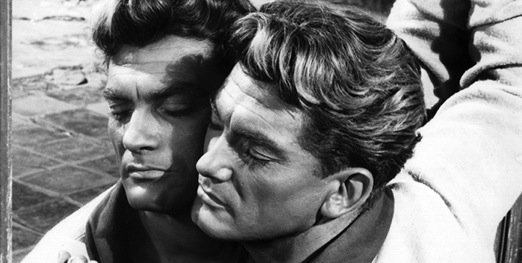
In Jean Cocteau's 1950 film Orphée, an improbable set of events lead a confused but tragically egoic poet on a counterintuitive journey through the underworld and back via mirror portals. Hounded by an uncompromising love for a Death which he claims for himself that propels him further and further from ordinary reality and its concerns, he ignores several warnings before missing and being partly responsible for the death of his pregnant wife, Eurydice. Death begins acting erratically when exposing herself to Time for this game, eventually being forced to sacrifice herself (in)to a mysterious further void for her own love of the poet, reflecting her own power onto herself to give her love more Time in life. The principle of Time and Void as reflective structures grows, a fulcrum-doubling, a crystalline nucleation from the future imposing its multi-faceted surface onto all past maps. Death as the strangest, strongest attractor in the circuit of life - but also given, and aggressively so. The pilgrimage toward the realm of separation marks the initiatory impulse of the monihilastic, the one who must “see for himself” the alone into the unknown the alone with the alone, the neuromancer tailing a white whaling rabbit past the mirror’s edge. However, the singular selfish soul seeds the field with disharmonious obsession, perceives only obstacles to knowledge, and is repaid in multiform dissolution of the attached identities. Oscillation between worlds is not their coinciding and bifurcation of the perspective is impossible under such circumstances. 

//“I am letting you into the secret of all secrets, mirrors are gates through which death comes and goes. Look at yourself in a mirror all your life and you'll see death at work like bees in a hive of glass.” -Heurtebise, Orphée//

A pair of focal attributes of Orpheus’ journey position the opening of our maze in a disastrous frame while indexing the trajectory of the penetration: the feminine, seen as a radically other and eventually identified with Death, is ignored, shunned, and avoided, presented as confusing and annoying like the buzzing of flies around the corpse of the protagonist’s great work - a work culled from a mysterious radio signal that fascinates Orpheus, unaware that they are in fact signals from the underworld/Death/the feminine itself. These signals are erratic, obscure, and drive Orpheus to obsession, representing the poet’s inability or unwillingness to accept the trinity of poetry, love, and death’s inseparability from the suffering made material of the world-space. French philosopher Michel de Certeau in various works has outlined a ruleset for “manners of speaking” the mystical function - one of them being a turn towards others’ texts while disclaiming one’s own - that we will use as part of a template for analyzing the works in this chapter in order to examine my contention that mystical death experiences are pervasive, that their primary neural function is an amplification and bifurcation of a geometrical perspective on the world-model, and that this bifurcation is the key to, among other things, an animus-alchemy of transmutation - a system for provoking evolution from discrete “closed individualism” viewpoints of binaryism/dualism into a unified flexible wholeness of perspective. This transmutation exhibits a fractal self-similarity to a growth beyond gender-dualism, which is why I choose to present particularly male art in this zone - to analyse clear metaphallegoric threads weaving this separation; to examine the gesture from ego-laden solipsistic penetration and “rational” negativity toward a communally-submissive union with the impenetrable unspeakable. The creative act contains all information about creation : any examination of the creative act can begin anywhere, for it consistently leads back to the voidmouth of pure unification, back to the immanent field.  

//Yet this train's whistle!

The wails of a lifetime were gathered in it from other nights in other slumbering years; the howl of moon-dreamed dogs, the seep of river-cold winds through January porch screens which stopped the blood, a thousand fire sirens weeping, or worse! the outgone shreds of breath, the protests of a billion people dead or dying, not wanting to be dead, their groans, their sighs, burst over the earth! - Bradbury, SWTWC//

The carnival train speeding into the small unnamed town in Bradbury’s Something Wicked drills through the sleeping boundaries of naïveté //clamouring, banging three different hymns mixed and lost, maybe not there at all// and initiates the bifurcation of entities that had never considered the possibility of their separation.  Jim and Will exist in one breath, are said to run as one unit, “mirror images”; but their birth, mere minutes apart, set the tone for their inexhaustible difference - Time’s chaotic generation and wilding force leaving its trace even on the smallest of scales. Yin and yang, birth a minute prior to the halloween-midnight dividing line leaves Will Halloway blonde and clean, pious, while Jim Nightshade is born a minute after, and called black-hat by Will’s father: the true protagonist of the story, Charles, the town librarian: 

//'You need a white-hat or a black-hat book?'

'Hats?' said Will.

'Well, Jim - ' they perambulated, Dad running his fingers along the book spines - 'he wears the black ten-gallon hats and reads books to fit. Middle name's Moriarty, right, Jim? Any day now he'll move up from Fu Manchu to Machiavelli here - medium-size dark fedora. Or over along to Dr Faustus - extra large black Stetson. That leaves the white-hat boys to you, Will. Here's Gandhi. Next door is St Thomas. And on the next level, well…Buddha.' - RB, SWTWC//

The text and the boys’ relationship resonates with duelling dualisms, binary gravities with centrifugal force - the generation of multiperspective begins with the simple oppositional negation of all givens, and one discovers, inside its oneness, a pair. Containing this pair, is the relation - the gap mutates the pairing entities into a one that is defined by the space between - there is no two: two is the one of united voidings, a pair of ones are not a two but instead the singular relation sinking into the emptiness between: a pair of ones make a one that is a zero: and Ø=∞. The negative potential in the gap is precisely where the autumn people of the carnival strike - the emptiness of non-knowing, of trust and faith’s lacking, of dreams and dreads held secret out of shame is the space of energetic expansion on which they feed, for it is precisely (in Heideggerian terms) //where danger is, that sublating power grows//. The carnival creatures exist on the vibrational signatures of idle selfish fantasy, feigned and real narcissism, and longing. They are seen as monstrous and inhuman by the boys, freshly planted in the fear and anxiety and excitement of the unknown. Great care is taken to portray them as exemplars of the frailty of the “human, all-too human” though, and as such are never truly monster, never wholly Other, never separate from the world they all once sought escape from. Charles particularly refuses the devolution into dualism and Other-ing, remembering that //if faces were judged, the freaks were no worse than many he'd seen slipping from the library late nights in his long career//. 

Charles, while playing a seemingly menial role of librarian/janitor/supporting character/too-old white voice to match white hair, develops in a wicked arc over the course of the story. From a man painfully re-living youthful memories in a dusty labyrinth of Time to a gnostic warrior taking on the world’s demons, Mr Halloway generates the motive force of the bodhisattva, the spiritual guide-structure of identification with the librarynth. As the boys’ paths diverge harder when pressed by the Dark, fear of and obsession with Time drive the wedge into their gap. Charles, prepared even beyond his reckoning by his own intimacy with such feelings of passive nihilism and active desire, performs the Bodhisattva’s Vow - performs the Tao - and fights without fighting, reasons with laughter and care in addition to hard-won knowledge, gathers fraying threads of individual egotisms fracturing under the weight of past and future sins in the unificatory gesture of a pitiless, desire-less, open love for all beings. This gesture is a negation of his own nihilism, encoded in the bindu point of separation - the speed at which age fractures the relationship between he and his son becomes the impetus for bridging the gulf of all ages: between Jim and Will, between he and Will, between knowledges past and the now. His refusal of the tainted gift of Time is the ultimate negation, the prima facie evidence of amor fati, the satori-marked disavowal of the self. 

Saturday, January 2, 2016

time-killing try-angles


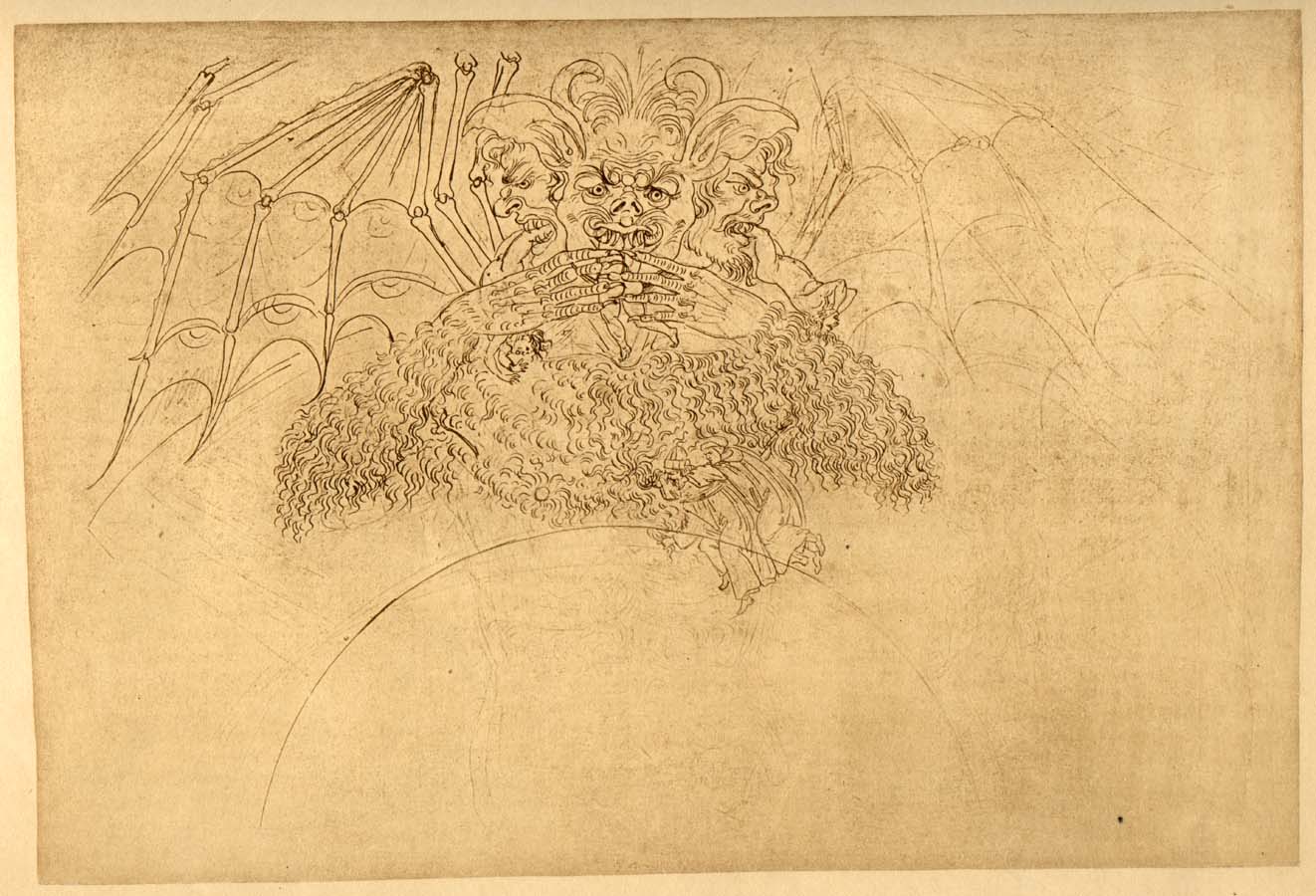
some notes and thoughts on Botticelli’s Lucifer as a report on Dante’s status at the end of this first stage of the spiritual journey.

As the Stygian realms of the underworld are penetrated by the spiral path, this intimacy with trauma generates the first waves of inhumanism in its traversing of interlocking rings of purifying, zones of annihilative unity. This inhumanism, far from being monstrous, however, diagrams the new multi-angle perspective spawned from this intimacy - humanism cannot survive the annihilation of self into a collective that includes all beings, and so shifts to existentialism. Existentialism folds under the weight of the direct experience of non-existence in mors mystica, and the entity that crosses this hedgerow is never again quite able to limit their identity to the inside of the human-animal perspective - Reza's inhumanism emerges as the posthuman identity that aligns purpose with the All, the One, the Spinozan Nature, the Buddhist conception of Mind, the collective unconscious, the "Gaian mind", this autonomy of Reason. As Dante comes to the center of the inferno his point of view progressively aligns with Lucifer’s, as the witness to divine justice is overlaid on the mechanism of this justice - the positioning of Lucifer in the center of the spiral gives the panopticon view of this unfolding circular/labyrinthine horror of Time, the view that must bear witness to the Real to grow wings sewn from Indra’s net. The alchemical metaphor of the Stone is laid upon the blacksmith's anvil, forged and shaped under tectonic pressures, alive in hellfire. This panopticon “god-like” view sparked from aligning self with all suffering inverts the Narcissus-like stasis of the spera, the central sphere, the mirror of the inferno - allowing an escape from hellish suffering found by penetrating through its core in an act of pure identification with the negative, or the self-overcoming of the central void of nihilism by integrating its nihilatory function into the self. This integration is the result of allowing the self to be annihilated, and being present and aware for the natural neural/mental reconstruction of the unified, unihilified, consciousness that has now a sense-able memory record of having free existence excised, taken from it, along with all closeness to the oppressed that this particular variety of trauma entails. The mirror maze is the purifying snow-white fire of the boundary between inferno and purgatorio, the mirrored-sphere of ice that prevents Lucifer from successfully ascending - because the way out is not up but further down.  

Thursday, October 1, 2015

initial sketches on precision neuronihilism

I'll probably get in trouble for this, but who cares. This is a draft (still needs lots of editing/endnotes etc) for an upcoming chapter in "Damned Facts: Fortean Approaches to the Study of Religion" due out sometime this winter on Aporetic. If you read this, give me some feedback.
EDIT 10/20/15: Almost done, cleaned up plus endnotes.

Mirror Maze: True Reflections of the Hyperprophets

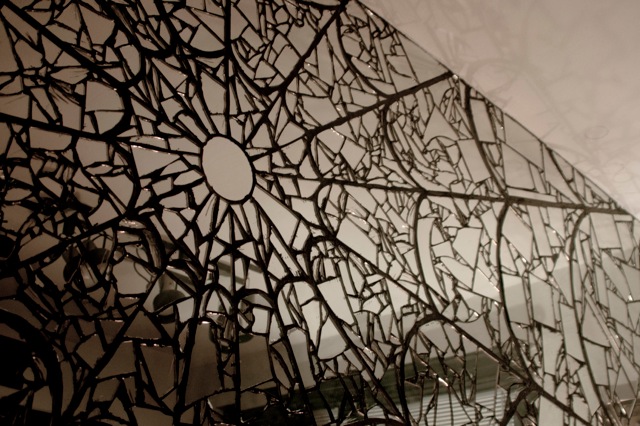
Broken mirror mosaic, author’s home (Construction: William Spencer; Photo: Chris Rice 2015)


Subtlety grates upon the nerves, yet everything is driven by an immense crudity: death impassions us. Even before crossing over into death I had been excruciated upon my thirst for it. I accept that my case is in some respects aberrant, but what skewers me upon zero is an aberration inextricable from truth. To be parsimonious in one’s love for death is not to understand. -Nick Land, Thirst for Annihilation1

This essay will likely seem serpentine, obscure, and repetitive, as I attempt to tie various speculations together that are, at the end of the day, just that - speculations. The reason I persist despite this limitation is that I believe the tools and technology exist and have always existed to plumb this particular depth in order to prove these theories right or wrong - my conjecture is that the potential is universal, though time will tell or it won’t. Perhaps it will spark anyone else to consider the possibilities contained herein and not be daunted by the solemnity and ghoulishness of Nothing! I am not the first to have foreseen an end to blind threading of the weave of world-space. I am not the first to "gaze long into the Abyss"2, nor am I the first to discover that our personal abysses can reflect the individuated Self. I am not the first to unwind and add my own Ariadne's thread through this intimate enfolding of Trauma and Time. I am not the first to attempt an Escape from this Mirror Maze, nor the first to theorize a mechanism for its navigation. I am not the first to swim up out of the hedgerow labyrinth into the ocean of Void. Nor am I the first to have brought back a vision of our underworld from the perspective of this "positive death at zero-intensity"3: a vision of infinitely multifold reflecting crystalline geometries hung on silver string in the aether. Like hyperconnected wireframe constellations, each node a virtual mirror - pages in books on shelves in the infinite librarynth of Self. To update Nietzsche: I have a multiplicity of precursors, and what a unity these precursors construct!4 No less than proof that the simulation of external reality by mind can be turned off completely or simulated as such, that this deactivation exposes details of future states, and that all recorded memory states are experienced simultaneously within this form of pure consciousness, modulated by incoming sensory input. Mors mystica - the experiencing of the Real in real time - exposes and forces a visualization of the calculatory procedures undertaken by the brain.

Simplicity. Lord, I do admire their direct approach. Hit an old man with mirrors, watch his pieces fall in jigsaws of ice.” -Something Wicked This Way Comes, Ray Bradbury5

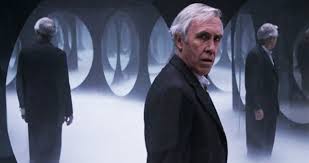
In my initial cartography of this concept I’ve taken to calling the Mirror Maze, I shall be paying a special notice to three primary points: an eclectic assortment of those who have went before, the nature of the intersections of these web-threads, and the layout, construction, and navigation of the labyrinth - the Prophets, the Mirrors, and the Maze. My narrative began some months before the writing of this, late one night watching the Disney adaptation of Bradbury's Something Wicked This Way Comes, I was struck suddenly by the remarkable similarity between the mirror maze scene and a half-remembered passage from Athanasius' biography of St Anthony:

He observed that in saying "today," he was not counting time that has passed but was always laying a foundation, endeavoring each day to stand before God and to attain an acceptable form in order to appear before God pure in heart and prepared to obey his will alone, and no other. And he used to tell himself from the way of life of the great Elijah that it was necessary for ascetics at all times to know their own lives, as in a mirror. -Antony the Great, Athanasius6

A psilocybin mushroom experience from months past in which I had perceived all memory laid out before me contained in seemingly-infinite, infinitely nested hierarchies and arrays of mirrors, mirrors that contained the seeds of future choices and linked by equally infinite spiderweb-thin strings extending back in time past my own beginning into Deep Time and on into Nothing, suddenly made a different kind of sense. A sudden realization of labyrinthine reflexivity, a synchronic reflection on so many past selves - dead but clearly unburied. Parts of this strange multilevel "past" were being constantly simulated and resimulated within the mind, these looping traps seeming to distort and bend the vanguard edge of creation back toward them, preventing the full range of forward motions. Sitting alone in the dark watching an old man drown in a mirror reflecting his greatest regrets, my vision went geometric and geomorphic and I began to weep while actively hallucinating. Self-reflection was enveloped by void-thoughts and shattered across a broken-mirrored wall. I saw my Death pirouetting in the reflective surface before I reflexively shook my head and snapped out of it in time for the credits to roll.

Something Wicked This Way Comes, Disney 1983

Re-struck by this strange-mirroring petit mors mystica, through a glass darkly, and recalling that nearly every mystical tradition made some use of the archetypes of the mirror, I began a scattershot approach to research that led me to a contused refracturing of viewpoint and attention span, overwhelmed by the chaos and brightness -the dripping intensity- of the mystical fascination with mirrors and reflection. In an attempt to re-focus my lens, as it were, I re-visited the movie that had generated this vision in the first place only to find that earlier in the film the carnival flyers Dark distributes through the town refer to the mirror maze as 'St. Anthony's Temptation.' A constellation began to coalesce out of the fog. While reflecting on Anthony, I was confronted immediately with a new mirroring, that of the visions of peaceful and wrathful deities of the Tibetan Book of the Dead and his visions, his 'Temptations.' This analogy transmutes righteous demonic combat into the struggle to overcome desire and attachment, linguistically refracting categories to remodel old wiring diagrams that re-express new purposes for old models and building a moving frame for a mobile interpretation of selflessness. In this ontological re-framing of ascetic repetition, Antony's meditation techniques mirror a yoga entrained on Death, as contortions of the mind and the contortions of the meat are trained to reflect each other with luminous precision - in his case a profound physical, mental, and emotional isolation in places such as crypts for extremely long periods of time. This asceticism and its resultant records mirror John Lilly's findings that such isolation "gives the fullest and most complete experiences of the internal explorations."8

But only the moon looked in at the hollow dark, the deep caverns. Outside, night beasts hung in midgallop on a carousel. Beyond lay fathoms of Mirror Maze which housed a multifold series of empty vanities one wave on another, still, serene, silvered with age, white with time. Any shadow, at the entrance, might stir reverberations the colour of fright, unravel deep-buried moons. If a man stood here would he see himself unfolded away a billion times to eternity? Would a billion images look back, each face and the face after and the face after that old, older, oldest? Would he find himself lost in a fine dust away off deep down there, not fifty but sixty, not sixty but seventy, not seventy but eighty, ninety, ninety-nine years old? The maze did not ask. The maze did not tell. -Ray Bradbury, SW9

In this way the mirror is related to vajrayana, the reflective prismatic "diamond" vehicle of enlightenment - this self-reflective vehicle providing a second axis of reflection on the ascetic's call to "know their own lives as in a mirror." The Diamond Sutra, a foundational text of vajrayana practice, is a short burst of directed anti-illusion ritual, a repetitive reminding of the interlocking shape of all things underlying the illusory world of differentiated names, the world of language - referencing constantly the nature of perception and communication as easily subverted by limiting forces such as language, myth, and the self-deception that anchors the individualized self-conception.

"I have seen the interconnectedness of all lifeforms. Once you become aware of this force for unity in life...you can't ever forget it. It becomes part of everything you do." -John Coltrane10

This illusion of disconnection segues into the concept of labyrinth, an oft-utilized metaphor for being lost in the hyper-intricate sum total of self and life. Both Mirror and Maze were often brought together in the work of Jorge Luis Borges, notably in the short story Library of Babel. Not only describing a functionally infinite librarynth with a crystalline structure complete with mirrors which the author "prefer[s] to dream that its polished surfaces represent and promise the infinite"11, Borges also writes "The mystics claim that their ecstasy reveals to them a circular chamber containing a great circular book, whose spine is continuous and which follows the complete circle of the walls; but their testimony is suspect; their words, obscure. This cyclical book is God. Let it suffice now for me to repeat the classic dictum: The Library is a sphere whose exact center is any one of its hexagons and whose circumference is inaccessible."12  Within the crystalline recording reflective structure of reality, the acknowledgement of zero as infinite and interpenetrating, of Zero as God.  
Virtual Mirrors

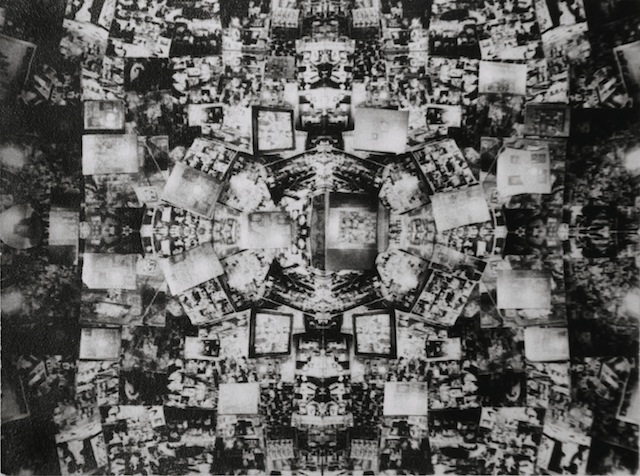
In the image titled 'Infinity' William S. Burroughs used a system of mirror and collage to combine every photograph he had thus far taken into one image, crystallizing Time in a richly resonant, recursive, mirror-mandala and providing him with access to his "memories" in a geometrically compressed supersymmetrical fashion. Recalling a book with several essays on WSB, I noticed that the title of one was Virtual Mirrors in Solid Time and was shocked to see someone else's work wyrdly prereflecting some of my own.


'Infinity' William S. Burroughs

Over the course of this essay, author Genesis P-Orridge analyses a set of artworks, judging them to be mystical oscillators: sorcerous art crafted with the purpose of driving a desired mental state in a viewer lucky enough to gaze on them. Art designed to trigger specific states of consciousness, transmitted via the open emotional conduit art generates in a receptive viewer, and based on a system of cues and nonlinear information encoding that mirror a path of shamanistic technology, the kind of "waveform mysticism" employed by skilled musicians and DJs. As much as the essay mirror-frames itself in a hypnagogic state between magic and mysticism, the essay recursively reflects on unexplored details of the gap between art's emotional resonance and neuroscientific attempts to quantify such resonance. The essay itself resonates with non-linear information encoding, becoming an autocommentary - a commentary on a mystical treatise that is itself a mystical treatise - reflecting this triggering system back at itself and finding a harmonic resonance in the re-presentation of these art works that both further entrenches and expands on the concepts under commentarial scrutiny, the concept in this case being the structural encoding of subjective experience into art. This process I believe mirrors the process of encoding sensory input into memory - a theory that the visionary artist's encoding of actual brain state information into a piece of art is significantly more dense or "complete" than any traditional models of art give it credit for, often even approaching lossless transfer of a subjective moment with a precision that transcends even what we already expect from art. Beyond a simple affective reaction into the transmission of the subjective experience via highly compressed thoughtforms across time and space. Burroughs’ photography was designed to trigger affectations of specific memories for himself, external memory storage that would emanate from - in a sense, be 'always on' - and become recursively sharpened by the object of art, a mirroring feedback loop that would culminate in a reification process for the memory, which Burroughs considered to be preeminent time travel technology. My speculation is that 'Infinity' was a recording of the Self-less empty state that presented an energy efficient memory recall method. This state of non-self finds an external equilibrium in the spacious emptiness behind the illusory, an equilibrium wherein  "even recursion, then, is not complex enough for a mirror so deeply synaesthetic and so causally complicated,"13 a self-reflection made remarkably mobile in time and space. The traumatic counterpoint to Self-loss found in his drug use resulted in precision encoding and transmission of these subjective states, presented as clearly as a face viewed in a mirror.

“All nature is a vast reflection of that which is within us, or else we could not know it.” Austin Osman Spare. - Subjective experience is no less "real" than objective conjecture. All roads lead to Rome in a mirror to mirror function. This function of mirroring is found in the trance state in a simple direct way. The higher techniques of idea and artist's illusory skills makes effects and phenomena active through the dimensions of Spacelessness and Timelessness in ways normally consigned to the sceptical parking lot of modern existence. -Genesis P-Orridge, Virtual Mirrors in Solid Time14

Proposed distinctions in art such as psychedelic, visionary, or occult take on a new form when re-interpreted this way. Removed from a somewhat crude sense of the artist's 'mindset', visionary art could possibly be redefined as art that successfully transmits salient information about some neurological state of the creator(s) via any medium - with an added speculation that these arts are frequently attempts at training or externalizing memory storage (even if only subconsciously) rather than a simple creative action, potentially explaining why so much art is interpreted as "meaningless" by people that aren't emotionally struck by it - by people that "can't remember" the memory being presented, who would therefore never feel an emotional resonance with the piece. P-Orridge elliptically suggests the reason this form of art is so good at conveying its encoded subjectivities is because of a natural self-deception in the form of "assuming what we view is an artwork, a picture, when in fact it is a 'photograph' of a mirror of virtual reality"15 which leads to an accidental openness to the suggestion encoded. This openness subverts skepticism toward the idea of "living, moving, or changing images of a post-death entity or brain essence"16 and attempts a wedging open of this gap, this openness to the Other, in the form of neurologically experiencing another's subjectivity.

[...] I came to find that certain artworks can produce their own sense of what is real....They demand that we remake our understanding in order to contain them. They resist our efforts to do so. In so doing art works, frequently, painfully and pleasantly remind me that my present understanding is profoundly insufficient. -Isabel Nolan, Weaponising Speculation17

Harmonizing with the knowledge that a sudden realization of the gaps in one’s understanding or awareness is a major component of the mystical experience, under this lens we see an expansion of perspective (even if ONLY by one) via a connection (even if ONLY a temporary neural connection between simulations) between the subject and the creator. For those of us predisposed to stable one-dimensional viewpoints, this expansion can be emotional indeed as the resizing of this stable self-awareness highlights the size of the unknown lurking in our knowledges and seems to dramatically reduce our sense of self-size as our perspective on ourself is made up now primarily of gap, of emptiness, of Nothing.18

Gaps, tensions, connections, and failures to fit appear when artworks are placed in a room. The empty spaces between works have properties that nothing does not. The spaces can have an array of qualities - they may be exciting, welcoming, disturbing, or alienating. I am not for a second suggesting that empty rooms don't have character or atmosphere, rather that artworks make new spaces and collapse existing ones. These non-neutral objects project themselves into a room and give shape to the nothing between them. -Isabel Nolan, WS19

Thalamocortical Oscillation (TCO) is an extremely underexplored facet of consciousness that is a crucial component of understanding more precisely what the mirror maze metaphor represents. TCO is loosely defined as the manifold high-dimensional path neurochemical signaling takes from sensory input collation, synchronization, and distribution in the thalamus to higher cognitive processing and representation in the cortex in addition to the frequency at which this path is stimulated by thalamic output measured in cycles per second. TCO frequency is roughly correlative to wakefulness and mood, with low frequency oscillations diving down through relaxation to hypnagogia and finally unconscious states like sleep; and higher frequencies more associated with active task-oriented focus and anxiety. The path the signal takes is determined by the top-down constraints and attentional navigation by the default network (the “ego”; DMN) of any number of high-dimensional neuronal maps that represent the active sensory stimulation, short-term memory, instincts, enculturation, and education of the subject as heterarchical supervening tiers overlaying the near-infinitely enfolded strata of raw sensory data encoded in deep memory. The brain is made up of several functional components that operate as oscillators upon this TCO waveform, the harmonic linkage - the resonance - of these "kluges" with the driving wave is modulated by the DMN. Psychedelic and mystical states are notable for their ability to perturb this efficient stable state to the point of collapse, at which stage these variously oscillating kluges individually home in on the most energy-efficient local periodic driver - generally the strongest environmental stimuli. Music, art, significant objects or entities, environmental and social cues of all kinds can pointedly and commandingly "snap" attention onto themselves and forcefully drive mental activity in these states, interrupting external reality with dreamlike components that are essentially fragments of memories related to the object under perceptual consideration.This knowledge seems to freshly illuminate the now-infamous Terence McKenna trope "5 grams in silent darkness," suggesting that TMK was offering up a blueprint for a harmonization with zero - a psychedelic harmonization with a sensory-null environment, a harmonization with Nothing. "The void-plane touched at zero-intensity"20, wherein awareness of self is cognitively lost and these dreamlike states completely obscure external reality.

In Cocteau's film Orphée, an improbable set of events lead a confused but tragically egoic poet on a counterintuitive journey through the underworld and back via mirror portals. Hounded by an uncompromising love of his Death that propels him further and further from ordinary reality and its concerns, he ignores several warnings before missing and being partly responsible for the death of his wife, Eurydice. Death begins acting erratically when exposing herself to Time for this game and eventually sacrifices herself to non-existence for her own love of the poet, reflecting her own power onto itself to give its love more Time in life. The principle of Time and Void as reflective structures grows, a crystalline nucleation from the future imposing its multi-faceted surface onto all past maps. Death as the strangest, strongest attractor in the circuit of life.  


Jean Cocteau’s Orphée, 1950

“I am letting you into the secret of all secrets, mirrors are gates through which death comes and goes. Look at yourself in a mirror all your life and you'll see death at work like bees in a hive of glass.” -Heurtebise, Orphée21

In all of these mirrors are found a common denominator, a shape lurking in every corner of every mirror, the outline of Death and its certainty as expressed in Time. In each mirror a threat and a promise. Considering several mystical, artistic, and literary works with this new visionary interpretation-framework and their overlap begins to expose this open secret. The hidden knowledge behind the fact that uncountable numbers of descriptions of Time and Death's machinations reverberate with the holographic reflective structuring of Memory. Works such as Infinity, the heretic Porete's 'Mirror of Simple Souls', Bradbury's Something Wicked, Cocteau's Orphée especially seem to amplify a signal that echoes the possibility of knowing our own Death, as intimately as a reflection in a mirror - a third axis of the ascetic maxim, which, along with the emulation of brain death in the mystical and psychedelic states, discloses this mode of non-linear, image-, archetype-, and pattern-based, topological cognition that intuitively acts to oppose the limitations of time via expression, i.e. the creation of memories, the creation of Time as Art. That, indeed, also seem to reference these possibilities of decoupling the timing control of the thalamus (leading to expansive feelings of timelessness and a disconnection from the concept of past/future as everything becomes Now) and relaxing completely its gating and filtration mechanism, shifting consciousness from an oscillatory and transient waveform in vector space to a solid standing wave that fills all available space - filling all gaps with signal instead of being limited to pre-constructed pathways. Signalling into these gaps illuminates their edges, sharpens their definition, and highlights the superstructure of memory as if it is all coterminous with the present moment.
...some of the best current work in neuroscience [...] suggests a view of the human brain as a system that constantly simulates possible realities. [...] Recent evidence points to the fact that background fluctuations in the gamma frequency range are not only chaotic fluctuations but contain information - philosophically speaking, information about what is possible. This information - for example, certain grouping rules, residing in fixed network properties like the functional architecture of corticocortical connections - is structurally laid-down information about what was possible and likely in the past of the system and its ancestors. [...] Not being chaotic at all, it might be an important step in translating structurally laid-down information about what was possible in the past history of the organism into those transient, dynamical elements of the processing that are right now actually contributing to the content of conscious experience. -Thomas Metzinger, Being No One22

....a passage that eerily mirrors the conception of the Mentat in Frank Herbert's Dune, whose divination is brought into sudden feasibility...

Unlike computers, Mentats were not simple human calculators. Instead, the exceptional cognitive abilities of memory and perception were the foundations for supra-logical hypothesizing. Mentats were able to gather large amounts of data and devise concise analyses in a process that goes far beyond logical deduction: Mentats cultivate "the naïve mind", the mind without preconception or prejudice that can extract the essential patterns or logic of data and deliver, with varying degrees of certainty, useful conclusions. -Dune Wiki23

Laplace’s description of absolute predictive knowledge does accord with the descriptions of prescience for Paul and Leto II. Prescience seems like a super-attunement to the present instant of time that brings with it a super-awareness of the possibilities for the future potential in the present instant.” Jeffery Nicholas, Dune and Philosophy24

This aligns mysticism with cutting-edge findings of neuroscience, bringing the fact that human brains are essentially anticipatory networks making guesses out of a patchwork past into the open void of the future, in line with the multitude of claims that several forms of meditative, yogic, emptiness-based rituals lead specifically to a higher-dimensional viewpoint of time, a viewing of the past such that the holofractalographic pattern of the creation of the Now in perceptive space is exposed through the cracks in our after-the-fact papering-over this Now via language. I theorize here that this viewpoint, by virtue of its perspective on the past, is able to utilize this knowledge to construct sharper and sharper guesses and hypotheses of the immediate future, of the expected reality to come rather than just the reality of the past, by tracking these strings of mirror shards forward in time. This similarly accords with the large bodies of work dedicated to the precognitive powers of the adept, though it also reminds us that these are only probable futures, that uncertainty in particular is impossible to stamp out in any of its forms and attachment to particular outcomes skews and deforms the process. Viewing the past in this way tends to humiliate anyone that was completely sure of their predictions or of formalized completeness, but it also paves the way for the suitably skilled, or suitably informed and aware, or even suitably aligned, to be a cognitive step ahead of those still in the realm of lower-dimensional individualized thinking - as this entity will maneuver maps with a qualitatively different kind of speed and clarity even if the landscape becomes more complex. In this sense, Burroughs was spot-on when he said "magic is just being there first" for it is no less than being attuned to the moment-to-moment creation vividly displayed in this metaphoric death of the self. This being-there-first is orthogonally exemplified by Coltrane's 'Om', exhibiting anothers’ contention that all time can be re-experienced, in particular by the use of a quote from the Vedas on the album:

"I am absolute knowledge
I am also the Vedas— the Sama, the Rik and the Yajus,
I am the end of the path, the witness, the Lord, the sustainer;
I am the place of abode, the beginning, the friend and the refuge;
I am the breaking apart, and the storehouse of life's dissolution:
I lie under the seen, of all creatures the seed that is changeless.
I am the heat of the sun; and the heat of the fire am I also;
Life eternal and death. I let loose the rain, or withhold it.
Arjuna, I am the cosmos revealed, and its germ that lies hidden."25

...which comes in tandem with his attempt to let the music be his thesis on the sound of the beginning of all things, a beginning some think he “saw” under the influence of psychedelic drugs. The word "om" is a vibration, a reflection of the unity of Nothing before creation. It is the manifestation of the truth essential to Hindu philosophy that Brahman (God) and the Atman (Soul) are one; that their separateness is an illusion. The acknowledgement of this truth, or rather the attempt to practice it, is what Coltrane seems to be doing with Om. The open secret of how LSD changed his outlook on reality in the early 60s casts an interesting light on his work that I speculate is not at all unrelated.26

Given the likelihood our brains have evolved to present a gapless experience, glossing over our enormous multi-dimensional lacks with simulations ranging from data-driven hypotheses to outright guesswork, is it possible we are just being presented with a dimensionally- or algorithmically-compressed reality? A reality in which the topology of the gap or interval is the true world-in-itself? Perhaps the Diamond Sutra is a technology for the reconfiguration of this high-dimensional constellation/circuit called the self-model such that it structurally aligns with the world-simulation-level map touted by Churchland in Plato’s Camera? A disciplined re-harmonization of Self such that the container and the self-model are brought into a structural isomorphism? A “psycholocator,” so to speak, combined with infinitely nested maps for the triangulation and navigation of an annihilation of all erroneous Selves and the final death of the primitive individualized ego? It is with these speculations in mind that I further adjust the angles of my mirror microscope and reconsider the set of artworks that are aligning themselves under this interpretation. Suddenly, a new pattern emerges from beyond the reflecting portal, the reflection of a pattern obscured by reactions to it..  
 
Librarynth
 
When the entire brain is opened into this involute infinity of zero-input, all memory is "viewed" from a higher spatial dimension, providing the god's-eye, rhizomatic observer-less point of view on the librarynth of Self/Knowledge, exposing its construction - exposing zero, the gap, as the stable centrality supporting the infinitely generative multidimensionality of consciousness. In laying zero as this mobile foundationless foundation, the central gap whose tendrils extend out infinitely as every gap, pre- post- and during Being is shown to be interconnected, Ø proves hyperscalar, dimensionless, rather than simply a starting point or as some abstract linear position eternally pre-beginning and out of range of phenomenal experience. Zero becomes interchangeable with the Sartrean perfect witness as this tracking-of-emptiness becomes a permanent ungrounding process of divorcing from preconceived ideals and habits - a mechanism for practicing the "undocking," so to speak, from ideology, culture, or self. A precision nihilism at the level of neural correlates to sense perception - where "passive nihilism is zero religion, active nihilism is the religion of zero."27 This reconfiguration easily overturns dualisms that would suggest anything other than Ø=∞, and indexes again that Ø represents a fundamental field of creative relation interpenetrating all things, as darkness has always been prior to light.

The pessimist’s day is not an illumined space for the advancement of experience and action, but a permanently and inescapably reflective zone, the vast interior of a mirror where each thing is only insofar as it is, at best, a false image of itself. Within this speculative situation, inside the doubleness of the mirror, pessimism splits into two paths, false and true, one that tries to fix pessimism (establish a relation with the mirror) and decides in favor of the apparent real, and another that totally falls for pessimism (enters the mirror) and communes with the greater reality of the unreal. -Nicola Masciandaro28

Re-evaluating the fractal mirrorscape this way would seem to index a repetitive ferocity to -remember- this “empty set" of neuronal coordinates in Art, to entrain thought and being toward the doom and discipline of time and inevitability, toward a new understanding of the strangest and most traumatic attractors, becoming a perennial philosophy of self-emptying into Art. Rembrandt's self-portraits in this sense transversally mirror The Picture of Dorian Grey as crystallized moments in subjective time are captured and encoded against finality. The pattern again invoked, a triumph over the fear of death not by solving a puzzle - but by accepting that it is puzzles all the way down. Every image you have ever taken of your reality has a You at its core that this self-reflection exposes as a container for sufferings that can be made larger by openness, by bringing it into contact with the Outside, and by a willingness to empty the container into the Art. This builds an angular momentum, like a feedback loop, toward the unification of the subject/object dualism, as if intension and extension align, a du[e/a]lling connection that reflects the unified self not just in aggregates of memory images but also in the process of constructing memories itself because you are this ever-growing reflective network that seems to expand beyond your self both in space and time, oscillating and expanding along with world-input, and so also the trajectory of the process is You and every gap is Nothing, but now a measurable Nothing - measurable in its interpenetration of multiple dimensions. When coordinated with the doctrines of interconnectedness presented in both quantum physics and biology, this structure crashes headlong into near-identical concepts as they provide a scaffolding for vajrayana, in the Diamond Sutra:

World-honored One, having listened to this Discourse, I receive and retain it with faith and understanding. This is not difficult for me, but in ages to come - in the last five-hundred years, if there be men coming to hear this Discourse who receive and retain it with faith and understanding, they will be persons of most remarkable achievement. Wherefore? Because they will be free from the idea of an ego-entity, free from the idea of a personality, free from the idea of a being, and free from the idea of a separated individuality. And why? Because the distinguishing of an ego entity is erroneous. Likewise the distinguishing of a personality, or a being, or a separated individuality is erroneous. Consequently those who have left behind every phenomenal distinction are called Buddhas all. -Diamond Sutra29  

Navigation

This is a primary axiom of self-navigation, an alignment with the gravity of zero, the gravity of non-existence. That the tuning and navigation of this librarynth is the fundamental skill set of philosophy, mysticism, psychology, science, and mathematics alike obscures the realization that a side-effect of holographic access to memory is that they will be ordered, in effect catalogued, by their emotional significance, the density of interconnection to and from their neural correlates in the hippocampus. The most significant memories - good and bad - will function like strange attractors exhibiting beacon-like gravity in proportion to their intensity. "lt is because she knows that not she or anyone else knows anything of her horrible sins and faults in comparison with what God knows of them." Porete says in ‘Mirror of Simple Souls’30, or as Tad Delay remarks in ‘God is Unconscious’, "A psychoanalytically informed theology is a conception of trauma. Regardless of who we pretend to be, our facades of humility and arrogance alike betray the deeply buried illusions we inflict upon ourselves with an irascible wrath, all for the misguided notion that our trauma will not surface and show itself through the veneer of security. The illusion of non-anxiety works until it does not."31
In correspondence with Marie von Franz titled Reflections on the Structure of the Universal Number Continuum, mathematician Jefferey Bishop makes a case for dimensional transition in geometric terms being a strange mirroring, a mirroring on each dimensional axis. It is a meandering and difficult text, looping and repeating itself, and even occasionally seeming to get lost in its own looping. In this sense it resembles Burroughs and Brion Gysin's cut-up experiments, seeming to break free of linearity via abstract self-reflection and what can be described in a tongue-in-cheek manner as dimensional travel - but this, a simulation based on finding or constructing transitional moments between mathematical dimension. As zero is the same zero in all dimensions, it becomes a kind of multi-axial elevator shaft connecting each coordinate of the librarynth to every other, a strange “tunnelling” through levels. An interesting takeaway from this piece comes at his contention that the 4th dimension requires a substantial inward-facing energy to be able to mirror and "invert" or more properly implode along 4 dimensional axes - represented in thought as a black hole of reflectivity that performs as its own attractor in this abstract vector space. "But the fifth dimensional element of symmetry is not an axis in any formal sense, and is altogether a more complex extension ‘into an unknown space.’ This is the symmetry element described as the non-performable operation of inversion through the center."32 In his terms, dimensional or scale transitions can only occur in spatial positions that conform to certain types of complexity, positions that align across dimensions such as zero, for systems capable of taking error-corrective action, of maintaining a balance.

At the moment of self-loss, whether virtual or actual, every point in the brain becomes electrochemically connected to every other point in the brain. This experience is often recalled as a feeling of hyperconnectedness, of "everything is everything" - a complete breakdown of the subject-object dynamic as the vast array and complexity of the sense stream often completely overwhelms any ability to recognize the self-model and the first-person perspective decays until all input and output are perceived simultaneously across all the senses. When this barrier has been passed, the subject ceases to perceive images directly from shared reality, being left only with their symbolic representation in mind. According to Julius Evola, “If the normal man is able to orient himself at all without the direct support of these images, he finds himself in a state of reverie, and then in the dream state, in which the energization of the imaginary activity, dissociated from the external senses, is accompanied by further reduction and emptying of consciousness of Self...further still and he enters into a state of apparent death”33 but another expression of balancing du[e/a]lisms as explicated by Land, "on the one hand death as the ultimate nostalgia of signification, on the other death as the virulent flux of communication"34 sets up a radical notion of balance as the diagonal solution for this di-lemma of the ego being trapped in the astonishment. Of particular use in the navigation of this state are the lessons learned from yoga, meditation, and vajrayana: acceptance, relaxation, breathing, preparation for mental contortion as one is funneled through the mirror-strung ego tunnel toward a “central” zone where we transcend reflection and become the mirror maze. This radical ungrounding presents the concept of an observer-less infinite perspective on all possible realities, in all directions, including internally, as the true world-for-itself.

He will travel freely through many worlds or experience - from direct contact with life-process forms and images, he may pass to visions of human game-forms. He may see and understand with unimagined clarity and brilliance various social and self-games that he and others play. His own struggles in karmic (game) existence will appear pitiful and laughable. Ecstatic freedom of consciousness is the keynote of this vision. Exploration of unimagined realms. Theatrical adventures. Plays within plays within plays. Symbols change into things symbolized and vice versa. Words become things, thoughts are music, music is smelled, sounds are touched, complete interchangeability of the senses. -Timothy Leary, The Psychedelic Experience35
...floating tomb [that] enshrines a dark abyssic twinness with the eternal, one spiritually defined by inverse suspension in a volitional forcefield of opposing attractors. The love that is its place is not soft, but adamantine, contentious, and operative in negation, in the form of resistance which permits not. Suspended with the finality of death in the divine abyss of itself, secure in the omnipresent center....the tomb is saturated with the blackness of this negativity, this NO, which holds the unthinkable thingless essence of creativity and everlasting freedom. -Nicola Masciandaro, Wings Flock to My Crypt, I Fly to My Throne36

We can suppose that this matrix stores information in a regressing hierarchy of interiorized reflections of itself, in a form similar to the familiar Chinese ivory balls carved one within another, each level free to rotate independently. -Terence McKenna, Invisible Landscape37

This presents a unique perspective on awareness when brought toward consilience with neuroscience and mysticism - that it may not be bound necessarily to being human, or even mammal or animal at all and could be a fundamental property of existence, possibly a type of empathy that expands our subjectivities via taking into account the subjectivities that surround us, viewing the Other not as if through a window, but as if we are their mirror. It is through this dream we realize Metzinger's proposition of transparency of self, and begin a methodology of opacity, a practice of observing the observer as it winks out of existence and subsequently rebuilds itself. A methodology of disallowing the self from interjecting over the interconnectedness, and an always-working-hypothesis of the eternality of Reason based on an alignment with the unknown - the infinite dissolution of our Selves in the boundless sea of hyperspace, the "infinite ocean of God."38  

When thought dissolves, we dissolve with it. Whoever we think we are dissolves into awareness that is free of the concept of self. In that very moment, we can directly experience the non-solidity of phenomena, the reality of emptiness, or shunyata. At the same time, there is so much energy present—so much so that it forms into another moment. The energy brings a sense of clarity that is so sharp, it is like a clear mirror in which mind can at last recognize itself. In this mirror of mind, we see the radiant yet transparent nature of our own awareness. -Dzogchen Ponlop, Mind Beyond Death39

In summation, the brain as a reflective structure may be no mere metaphor, deep physical and emotional isolation exposes the jagged edges and missing pieces of our inchoate selves, and subjective experience seems to be constructed by the closing of or simulation over perceived gaps between already-hyperconnected multi-level nodes of sensory recordings in the brain by analogy, logical connections in abstract thought, and causal/spatial/temporal "adjacency" (direct experience). The shift from a spatial abstraction (3 dimensional external reality) to a higher dimensional temporal abstraction gives us a simulated "top-down" view of our entire self-memory, but the transition between these dimensions involves traversing a hyper-mirroring "ego-tunnel" that exposes us to a totalized reflection of our utterly incomplete yet utterly interconnected selves and generates an automatic gravity toward the replay of emotionally significant memories while showing just how malleable memory is within emotional space. That this could be of profound importance to psychotherapy belies the fact that it is, quite simply, terrifying for the traumatized as the worst *always* comes first. The training received in yogic and ascetic practices take on incalculable value, as a kind of never-ending deconstructive "self-less" balancing act seems to be the only method for remaining within this space - this, the charnel ground of the infinitely blissful horror of pure self-knowledge. As the entrance to the Mirror Maze can be found in every Self, so the Escape is found in Self-less-ness.


Numerological Graphings of several words and phrases -Nick Land, Fanged Noumena (Falmouth: Urbanomic, 2011)


​"Homological Scaffolds of Brain Functional Networks" G. Petri, P. Expert, F. Turkheimer, R. Carhart-Harris, D. Nutt, P. J. Hellyer, F. Vaccarino
J. R. Soc. Interface 2014 11 20140873; DOI: 10.1098/rsif.2014.0873. Published 29 October 2014

Neural Net Map - http://www.brainmaps.org

Endnotes
1: Nick Land, Thirst for Annihilation: George Bataille and Virulent Nihilism (London: Routledge, 1992), 15.


2: Nietzsche, Beyond Good and Evil - Aphorism 146 (London: Penguin, 2003). This fragile lacework narrative must necessarily be limited by page constraints. Though it forms from a constructive unfolding web of disciplined retracings of steps, it has proven to be a particularly complex journey and will be plagued by speculation as long as the exploration of inner worlds continues to be considered outside the purview of the hard sciences (not to mention, in the case of psychedelics, the law).


3: Nick Land, Thirst for Annihilation: George Bataille and Virulent Nihilism (London: Routledge, 1992), 81.


4: Nietzsche, Postcard to Franz Overbeck, Sils-Maria (30 July 1881) as translated by Walter Kaufmann in The Portable Nietzsche (London: Penguin, 1954).  "I have a precursor, and what a precursor!" referencing Spinoza.


5: Ray Bradbury, Something Wicked This Way Comes (New York: Avon, 2006), 112.


6: Athanasius of Alexandria, Life of Antony trans. Tim Vivian. Coptic Church Review: Volume 15, Numbers 1 & 2 (1994), 8.


8: John C. Lilly, Programming and Metaprogramming in the Human Biocomputer (Portland: Coincidence Control Publishing, 2014), 15.


9: Ray Bradbury, Something Wicked This Way Comes (New York: Avon, 2006), 31.


10: John Coltrane, Sleevenotes of Meditations (Impulse, 1966).


12: Ibid.


13: Karmen MacKendrick, “The Voice of the Mirror: Strange Address in Hildegard of Bingen” in “The Mystical Text (Black Clouds Course Through Me Unending…),” eds. Nicola Masciandaro and Eugene Thacker, special issue, Glossator: Practice and Theory of the Commentary 7 (2010), 212.


14: Genesis P-Orridge, “Virtual Mirrors in Solid Time” in Book of Lies, ed. Richard Metzger (New York: Disinformation, 2003), 136.


15: Ibid., 134.


16: Ibid., 134-135.


17: Isabel Nolan, “How to Make Space-Time and Influence People” in Weaponising Speculation (New York: Punctum, 2014), 39.


****18: James Harris, “Mycelegium” in Mors Mystica: Black Metal Theory Symposium 4 ( NEED CITY :Schism, 2015), 81-97.


19: Isabel Nolan, “How to Make Space-Time and Influence People” in Weaponising Speculation (New York: Punctum, 2014), 41.


20: Nick Land, Thirst for Annihilation: George Bataille and Virulent Nihilism (London: Routledge, 1992), 77.


21: Orphée. Written/Directed by Jean Cocteau (Paris: DisCina, 1950).


22: Thomas Metzinger, Being No One: The Phenomenal Self-Model Theory of Subjectivity (Cambridge: MIT Press, 2004), 51-52.


24: Dune and Philosophy: The Weirding Way of the Mentat ed. Jeffery Nicholas (Chicago:Open Court, 2011), 81-82.


25: John Coltrane, Om (MCA, 1989).


27: Nick Land, Thirst for Annihilation: George Bataille and Virulent Nihilism (London: Routledge, 1992), 103.


29: Diamond Sutra trans. A. F. Price and Wong Mou-Iam (Boston: Shambala, 1990), 32.


30: Marguerite Porete, Mirror of Simple Souls trans. Hugo M. Van Woerkom (unpublished), 34.


31: Tad Delay, God is Unconscious (Eugene: Wipf and Stock, 2015), xiii.


32: Jeffery Bishop, Reflections on the Structure of the Universal Number Continuum http://vixra.org/pdf/1105.0008v1.pdf (2011).


33: Julius Evola, The Hermetic Tradition (New York: Inner Traditions International, 1971), 104–105.


34: Nick Land, Thirst for Annihilation: George Bataille and Virulent Nihilism (London: Routledge, 1992),125.


35: Timothy Leary, Richard Alpert, Ralph Metzner, The Psychedelic Experience: a Manual based on the Tibetan Book of the Dead. http://www.holybooks.com/wp-content/uploads/Timothy-Leary-The-Psychedelic-Experience-The-Tibetan-Book-Of-The-Dead.pdf (1964), 26.


****36: Nicola Masciandaro, “Wings Flock to My Crypt, I Fly to My Throne: On Inquisition’s Floating Tomb” in Mors Mystica: Black Metal Theory Symposium 4 (CITY: Schism, 2015), 379.


37: Terence McKenna, The Invisible Landscape (New York: HarperCollins, 1993), 75.


38: William James, Varieties of Religious Experience (New York: Barnes and Noble, 2004), 342.


39: Dzogchen Ponlop, Mind Beyond Death (Ithaca: Snow Lion, 2008), 17.